Quick answer
A backflow prevention assembly keeps water from your irrigation, fire sprinkler or building system from flowing back into the public supply. LADWP and most other water agencies require each assembly to be tested every year by a qualified tester, with results filed by a deadline. The test takes under an hour, and a failed assembly gets repaired or replaced, then retested.
What a backflow assembly actually protects
Water normally moves one way: from the main in the street, through your meter, into the property. Backflow is when it reverses. A sudden pressure drop in the street main, such as a hydrant opened nearby or a broken main, can siphon water backward out of your plumbing. That's back-siphonage. Backpressure is the opposite problem, when a pump, boiler or elevated tank on your side pushes harder than the city supply.
Either way, whatever sits in your pipes could reach the public system: fertilizer from an irrigation line, stagnant water from a fire sprinkler loop, or treated water from a boiler. The assembly is a pair of spring-loaded check valves, sometimes with a relief valve between them, that only let water move forward.
- Reduced pressure assembly: two checks plus a relief port, used on higher-hazard connections like boilers, chemical feeds and many commercial buildings
- Double check assembly: two checks without a relief port, common on fire sprinkler lines
- Pressure vacuum breaker: a single check with an air inlet, often found on landscape irrigation
Why the water department writes to you every year
Springs weaken, rubber seats harden and debris lodges in check valves, and none of that shows from the outside. So LADWP requires every backflow assembly in its service area to be tested once a year by an approved tester, with results sent back to the utility by the date on your notice. Ignore enough notices and the utility can escalate, up to shutting off water at that connection.
Outside the City of Los Angeles, the letter comes from whoever runs your water. Burbank, Glendale, Pasadena and Long Beach each run their own water departments, and many other cities and water districts in the county do the same. Schedules and paperwork differ a little, but the yearly test is standard across the region.
Many single-family homes have no testable assembly at all. The ones that do usually have it on a dedicated irrigation meter, a fire sprinkler system, a pool fill line with chemical feed, or a well. Apartment buildings, restaurants and medical offices are where most assemblies live.
What happens during the test
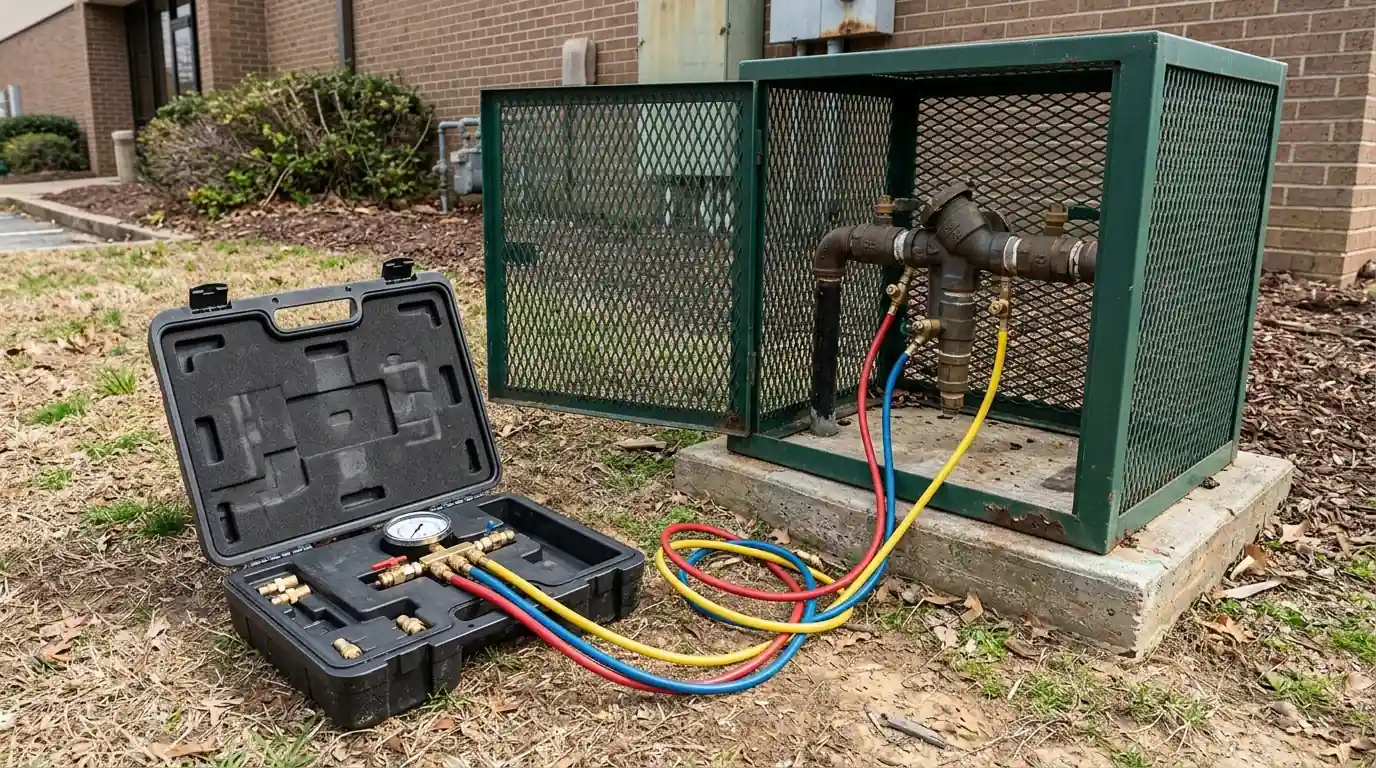
The tester closes the downstream valve, hooks a differential pressure gauge to the small test cocks on the assembly, and checks each part in turn. On a reduced pressure assembly that means confirming each check valve holds the required pressure difference and that the relief valve opens at the right point. Water to whatever the assembly serves is off for roughly fifteen to forty-five minutes.
If everything passes, the assembly gets a dated tag and the results go to the water agency. If something fails, the tester records which part failed, and the assembly needs repair before it can pass a retest. Ask for a copy of the field sheet either way, since it shows the actual readings and not just pass or fail.
Readings that pass but sit close to the minimum are worth noting. A check valve that barely held this year is likely to fail next year, and rebuilding it on your schedule beats a surprise failure a week before the agency deadline. When we test, we point out borderline numbers on the sheet so you can plan the repair instead of reacting to it.
Why assemblies fail and what fixing them involves
Most failures are plain wear. Rubber discs harden in the sun, springs lose tension, and in LA's hard water, scale builds on the seats until the checks don't close tight. Sand or pipe debris stirred up by street main work can hold a check open, which is why failures sometimes follow city repairs on your block.
A failing reduced pressure assembly often announces itself by dumping water from its relief port, sometimes in a steady stream. That's the device doing its job, but it also means a check valve is leaking through. Repair usually means a rebuild kit with new rubber parts and springs, then a retest the same day. Discontinued models and bodies with cracked castings get replaced.
Theft is a real problem across the region. Brass assemblies get stolen for scrap, especially at commercial lots and apartment buildings, which leaves a property without water. A locking cage bolted to a concrete pad slows thieves down and protects the assembly from mowers and trimmers too.
Getting ready for test day
Most delays on test day come from access. Make sure the assembly isn't buried under shrubs, the cage key is available, gate codes work and dogs are inside. Turn off irrigation clocks so a station doesn't start mid-test and skew the readings. Have the notice handy too, because the serial number and location code on it tell the tester which device the agency expects to see results for.
For apartment and multi-unit buildings, post a notice for tenants, since the domestic water or fire line may be off briefly. Restaurants should schedule testing outside peak hours, ideally in the same visit as routine commercial plumbing maintenance.
Keep copies of every test report. If the agency says it never received results, a dated copy settles it quickly, and it gives the next tester a history of which parts have already been rebuilt.
Typical costs for testing, repair and replacement
Typical ranges, not a quote, for Los Angeles properties. Several assemblies at one site cost less each to test, while size, access and whether a replacement needs a permit and new piping change the total.
When we come out for backflow testing, we also put a gauge on the incoming line. If street pressure is running high, a pressure regulator protects the assembly and everything after it from the constant strain.
- Annual test of one assembly: $75 to $200
- Rebuild of a small reduced pressure or double check assembly, with retest: $200 to $600
- Replacement of a three-quarter to one inch residential assembly: $600 to $1,500
- Replacement of a two inch commercial reduced pressure assembly with cage: $2,000 to $5,000