Tankless Water Heater Installation
Gas and electric tankless water heaters installed with a properly sized gas line, sealed venting, isolation valves for descaling and a condensate drain where needed.
See the detailsRepairs & emergencies
Emergency PlumbingLeak DetectionSlab Leak RepairBurst Pipe RepairToilet RepairFaucet RepairGarbage Disposal RepairShower Valve RepairPressure Regulator ReplacementOutdoor Spigot RepairDrains & sewer
Drain CleaningMain Line Clog ClearingHydro JettingSewer Camera InspectionSewer Line RepairTrenchless Sewer ReplacementSewer Cleanout InstallationStorm & Yard Drain CleaningWater heaters
Water Heater RepairWater Heater ReplacementTankless Water Heater InstallationTankless Water Heater ServiceHeat Pump Water Heater InstallationWater Heater Earthquake StrappingHot Water Recirculation PumpPipes, gas & water lines
Whole-House RepipingMain Water Line ReplacementShutoff Valve ReplacementGas Line RepairGas Line InstallationSeismic Gas Shutoff ValveBackflow TestingWater Softener InstallationWhole-House Water FiltrationFixtures, remodels & property
Toilet InstallationFaucet & Sink InstallationKitchen PlumbingBathroom Remodel PlumbingADU PlumbingPlumbing InspectionApartment Building PlumbingCommercial PlumbingGrease Trap ServiceCity of Los Angeles
Los AngelesResedaWinnetkaCanoga ParkWest HillsTarzanaChatsworthPorter RanchGranada HillsNorth HillsLake BalboaPanorama CityValley GlenSun ValleyPacoimaSylmarSunland-TujungaSan PedroWilmingtonMission HillsValley VillageHarbor CityLA and Ventura county cities
Santa ClaritaSan FernandoBurbankGlendalePasadenaCalabasasThousand OaksSimi ValleySanta MonicaInglewoodHawthorneTorranceCarsonLong BeachComptonMore LA County cities
DowneyNorwalkLakewoodEl MonteWest CovinaWhittierPomonaAlhambraArcadiaCovinaBeverly HillsCulver CityRedondo BeachBellflowerSouth GateOrange County and Inland Empire
AnaheimSanta AnaIrvineHuntington BeachOrangeFullertonGarden GroveCosta MesaRancho CucamongaOntarioCoronaCounties
Los Angeles CountyVentura CountyOrange CountySan Bernardino CountyRiverside CountyYour tankless heater is throwing an error code, sending water that swings between hot and cold, or taking longer to heat than it used to. Mineral scale or a tired ignition part is usually behind it, and both are fixable.
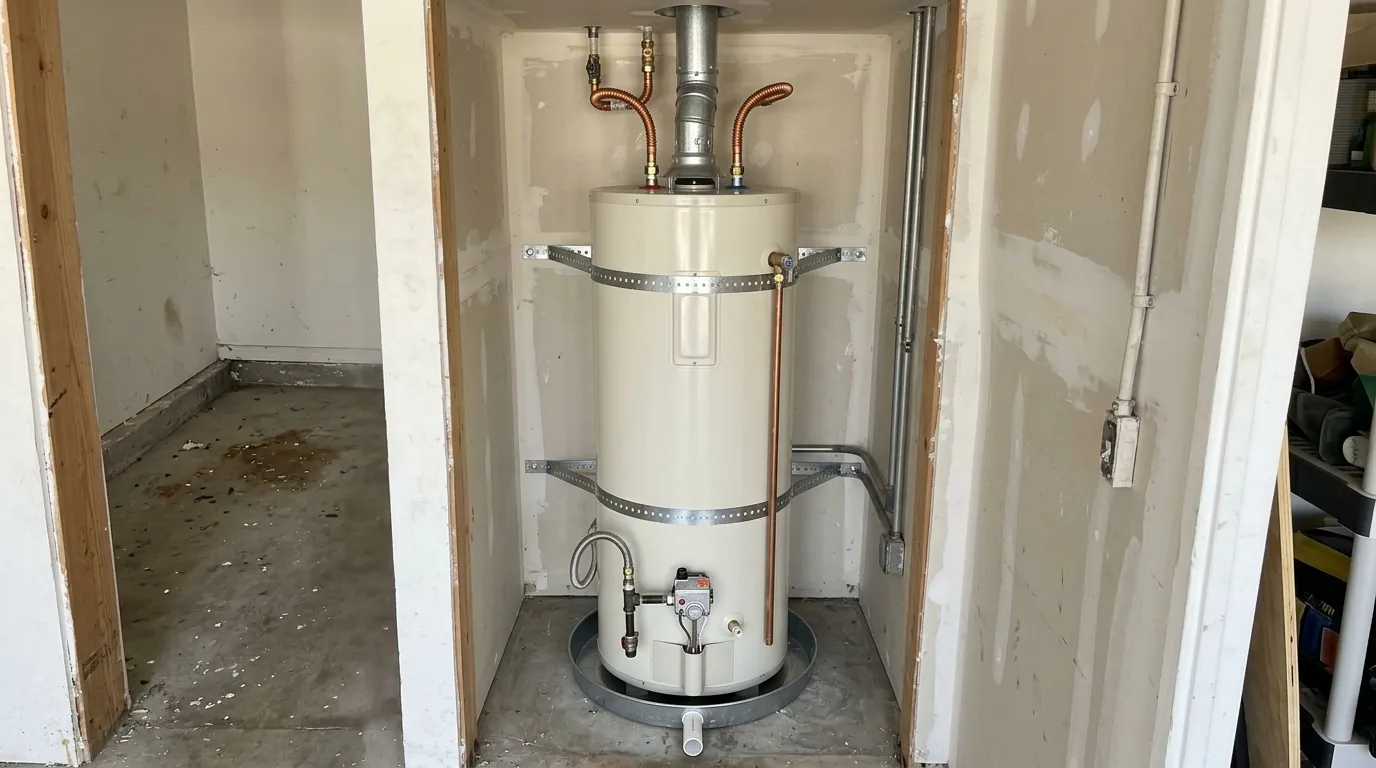
Tankless service means flushing scale out of the heat exchanger with a descaling solution, cleaning the inlet screen, checking gas pressure, venting, combustion parts and the condensate drain, then reading any stored error codes. With Los Angeles hard water, most units need a flush every year. Call sooner if you see codes, temperature swings or reduced hot water flow.
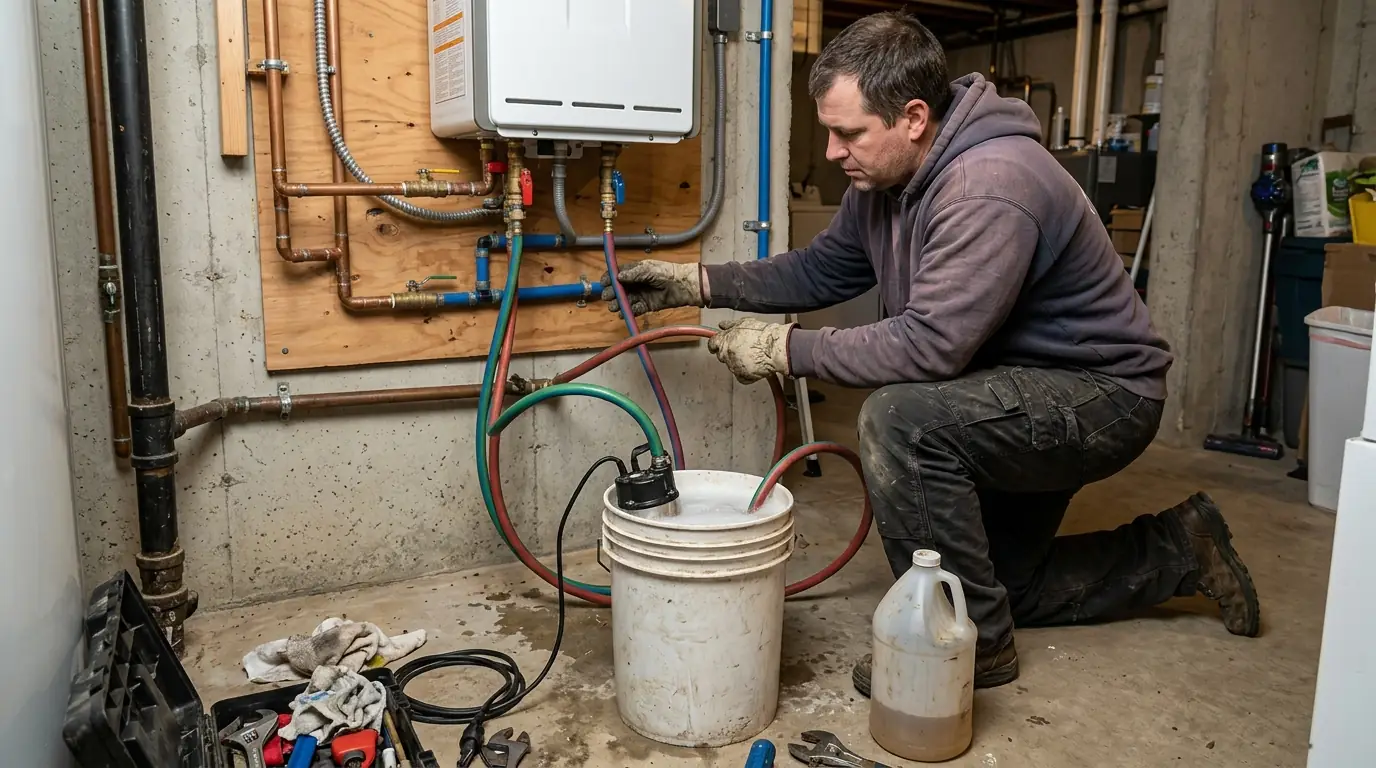
We start by shutting off gas and power, closing the hot and cold isolation valves under the unit, and opening the purge ports. A small submersible pump then circulates a food-grade descaling solution, usually citric or vinegar based, through the heat exchanger for about an hour.
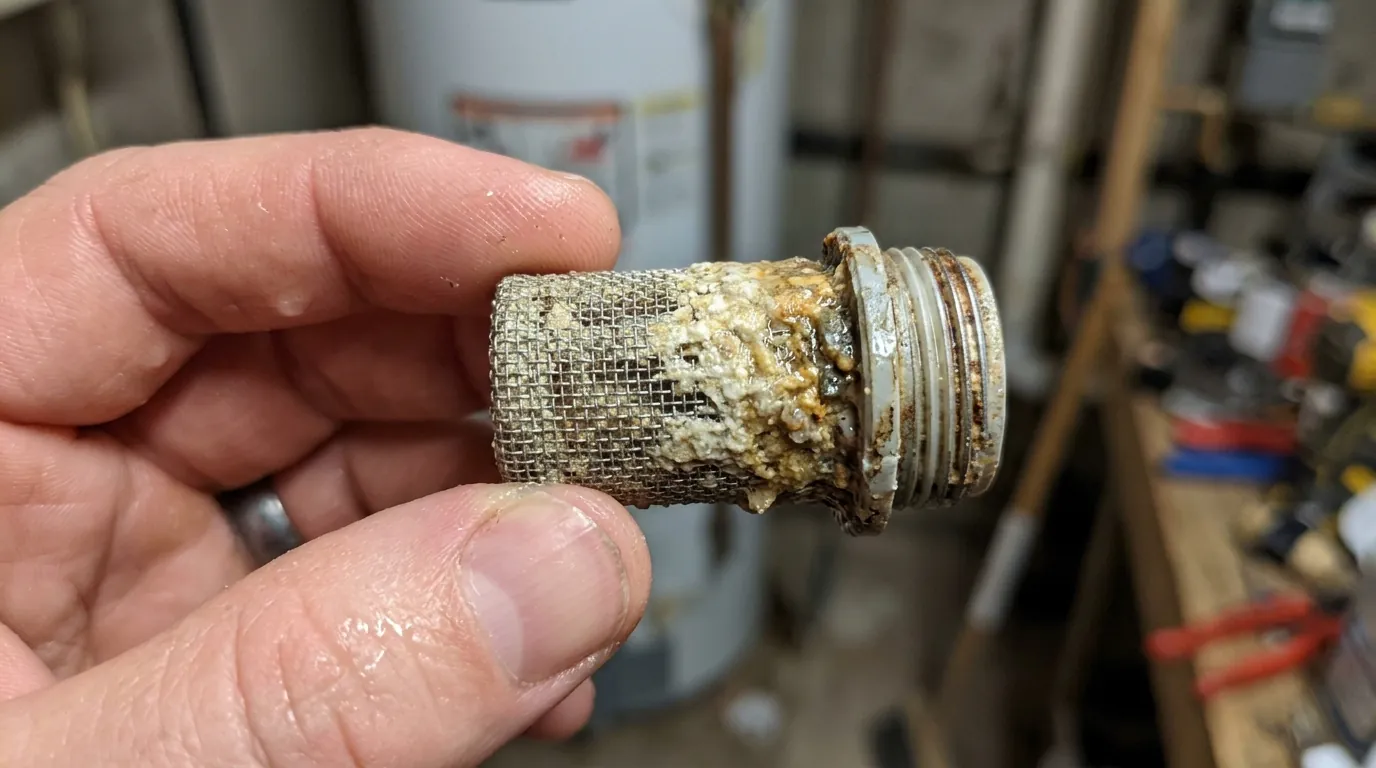
After the flush we rinse with fresh water, pull and clean the inlet screen, and check the flow sensor for buildup. Then we restart the unit, watch the flame, take a temperature reading at the nearest tap and confirm the heater fires at the flow the manufacturer expects.
Some heaters were installed with no isolation valves, which leaves nowhere to hook up the pump. In that case we fit a service valve kit first. It turns every later flush into a short visit instead of a cut-and-solder job.
Most manufacturer schedules assume moderate water. LADWP and many neighboring water departments deliver Colorado River and State Water Project supplies, both carrying dissolved calcium and magnesium. A tankless exchanger has narrow passages and heats water in seconds, which is exactly the condition that drops minerals out of solution and bakes them onto the metal.
A tank heater hides scale at the bottom of the tank for years. A tankless unit shows it within months as weaker flow, higher exhaust temperature and overheat codes. A softener slows the buildup a great deal, though we still look at the exchanger once a year. Our guide to what hard water does in LA homes explains the chemistry in plain terms. High temperature settings speed up scaling too, so a lower setpoint helps.
Not every tankless complaint is scale. A unit that clicks but never lights may have a worn igniter, a dirty flame rod or a gas valve that will not open. We test each part instead of swapping them on a guess, and we carry common igniters and sensors for the brands we see most in LA garages.
Gas supply is a frequent hidden cause. A tankless heater can demand far more gas at full fire than the old tank did, and homes that were never upsized starve the burner when the dryer and furnace run at the same time. We measure pressure at the unit under full load, and if the pipe is undersized our gas line repair work can bring it up to size.
Heat exchangers do fail, usually from scale overheating the metal or from corrosion on a unit that was never flushed. On an older heater, a replacement exchanger can cost a large share of a new one. We put both numbers side by side so you decide with real figures in front of you.
If you lean toward replacing, our tankless installation work covers sizing, venting and gas upgrades. Some homeowners go back to a tank or switch to a heat pump instead, and our article on tank, tankless and heat pump tradeoffs lays out the differences.
Condensing models deserve their own note. They produce acidic condensate that has to pass through a neutralizer before it reaches a drain. Once the neutralizer media is spent, that acid etches drain lines and concrete, so we check and refill it on every visit.
Plenty of LA tankless units hang on exterior walls, where Valley summer heat and harbor salt air both work on the cabinet. Near the water in San Pedro and Wilmington, salt air corrodes vent caps and screws faster, so we look closely there. In attic installs we check the condensate path and drip pan, since a leak overhead ruins ceilings. Hard water is the biggest local factor, and older neighborhoods with original small SoCalGas branch lines are the second. Units in tight garage corners also get boxed in by storage, which starves the burner of air.
Warning signs
On the job
We pull stored error history from the controller and ask what you have noticed, such as when cold bursts happen and which taps are affected.
We measure inlet gas pressure at full fire and look over every vent joint and termination for blockage, separation or bird nests.
With the isolation valves closed, we circulate descaling solution through the unit, then rinse until the water runs clear.
The inlet filter, flow sensor and flame rod get cleaned or replaced, and on condensing units we inspect the neutralizer.
We run two fixtures at once, read outlet temperature and confirm the heater holds steady before we pack up.
Typical pricing
Price depends mostly on whether service valves already exist, how much scale is inside the exchanger, and whether a part has to be ordered for your brand.
| Job | Typical LA range |
|---|---|
| Descaling flush with inlet screen cleaning | $175 to $350 |
| Service valve kit fitted before the first flush | $250 to $550 |
| Igniter, flame rod or flow sensor replacement | $300 to $750 |
| Condensate neutralizer replacement | $150 to $350 |
| Heat exchanger replacement | $900 to $1,800 |
These are typical ranges, not a quote; brand, part availability, attic or exterior access and venting condition all move the final number. See every job in our LA price guide.
Questions we hear
With LA hard water, we suggest a tankless flush every year for most homes, and every six months if you run the heater hard, keep the setpoint high or have no softener. Homes with a working water softener can often stretch to every two years, though we still like to look at the inlet screen and exchanger annually.
If the unit has isolation valves, a careful homeowner can run a basic vinegar flush with a bucket pump. The parts people miss are the inlet screen, the flow sensor, gas pressure and the condensate neutralizer, and those are where many problems actually hide. If your heater has no service valves, leave the flush to a plumber.
Some units lose settings or detect a flame fault when power returns while gas is flowing. Turn the unit off and back on once. If the same code returns, the outage probably exposed a weak part, often an igniter or a control board hit by the surge.
When you shut a tap and reopen it quickly, cooled water sitting in the pipe reaches you before the heater refires. A few seconds is normal. Longer cold stretches point to a dirty flow sensor or low-flow fixtures that no longer trigger the burner. A recirculation setup can also shorten the gap.
Usually only on newer units. The exchanger is the most expensive part in the cabinet, and on an older heater the repair can approach the price of replacement. We price both options before touching anything, and we tell you if the fan, board or gas valve are also showing their age.
Coverage
These are the communities that call us for this most often, with their main ZIP codes. The same 24/7 line covers every one of our 68 service areas.
Often booked together
Gas and electric tankless water heaters installed with a properly sized gas line, sealed venting, isolation valves for descaling and a condensate drain where needed.
See the detailsSofteners sized to your household and water hardness, plumbed at the main with a bypass, a proper drain and a separate unsoftened line where you want one.
See the detailsWe trace gas leaks with gauges and detectors, repair or replace damaged pipe and fittings, and pressure test the line before your appliances go back on.
See the detailsGas and electric tank water heaters diagnosed and repaired: pilot and thermocouple faults, gas valves, burners, elements, relief valves and leaking fittings.
See the detailsCall the line any hour. A plumber answers, asks what you are seeing and tells you what happens next.