Sewer Camera Inspection
A waterproof camera run through your sewer lateral to show cracks, roots, bellies and offsets on video, with depth and location marked before any digging is planned.
See the detailsRepairs & emergencies
Emergency PlumbingLeak DetectionSlab Leak RepairBurst Pipe RepairToilet RepairFaucet RepairGarbage Disposal RepairShower Valve RepairPressure Regulator ReplacementOutdoor Spigot RepairDrains & sewer
Drain CleaningMain Line Clog ClearingHydro JettingSewer Camera InspectionSewer Line RepairTrenchless Sewer ReplacementSewer Cleanout InstallationStorm & Yard Drain CleaningWater heaters
Water Heater RepairWater Heater ReplacementTankless Water Heater InstallationTankless Water Heater ServiceHeat Pump Water Heater InstallationWater Heater Earthquake StrappingHot Water Recirculation PumpPipes, gas & water lines
Whole-House RepipingMain Water Line ReplacementShutoff Valve ReplacementGas Line RepairGas Line InstallationSeismic Gas Shutoff ValveBackflow TestingWater Softener InstallationWhole-House Water FiltrationFixtures, remodels & property
Toilet InstallationFaucet & Sink InstallationKitchen PlumbingBathroom Remodel PlumbingADU PlumbingPlumbing InspectionApartment Building PlumbingCommercial PlumbingGrease Trap ServiceCity of Los Angeles
Los AngelesResedaWinnetkaCanoga ParkWest HillsTarzanaChatsworthPorter RanchGranada HillsNorth HillsLake BalboaPanorama CityValley GlenSun ValleyPacoimaSylmarSunland-TujungaSan PedroWilmingtonMission HillsValley VillageHarbor CityLA and Ventura county cities
Santa ClaritaSan FernandoBurbankGlendalePasadenaCalabasasThousand OaksSimi ValleySanta MonicaInglewoodHawthorneTorranceCarsonLong BeachComptonMore LA County cities
DowneyNorwalkLakewoodEl MonteWest CovinaWhittierPomonaAlhambraArcadiaCovinaBeverly HillsCulver CityRedondo BeachBellflowerSouth GateOrange County and Inland Empire
AnaheimSanta AnaIrvineHuntington BeachOrangeFullertonGarden GroveCosta MesaRancho CucamongaOntarioCoronaCounties
Los Angeles CountyVentura CountyOrange CountySan Bernardino CountyRiverside CountySewage backing into a tub, a soggy patch in the yard or the same clog every few months usually means the pipe itself has failed. We find the broken section on camera and repair that stretch.
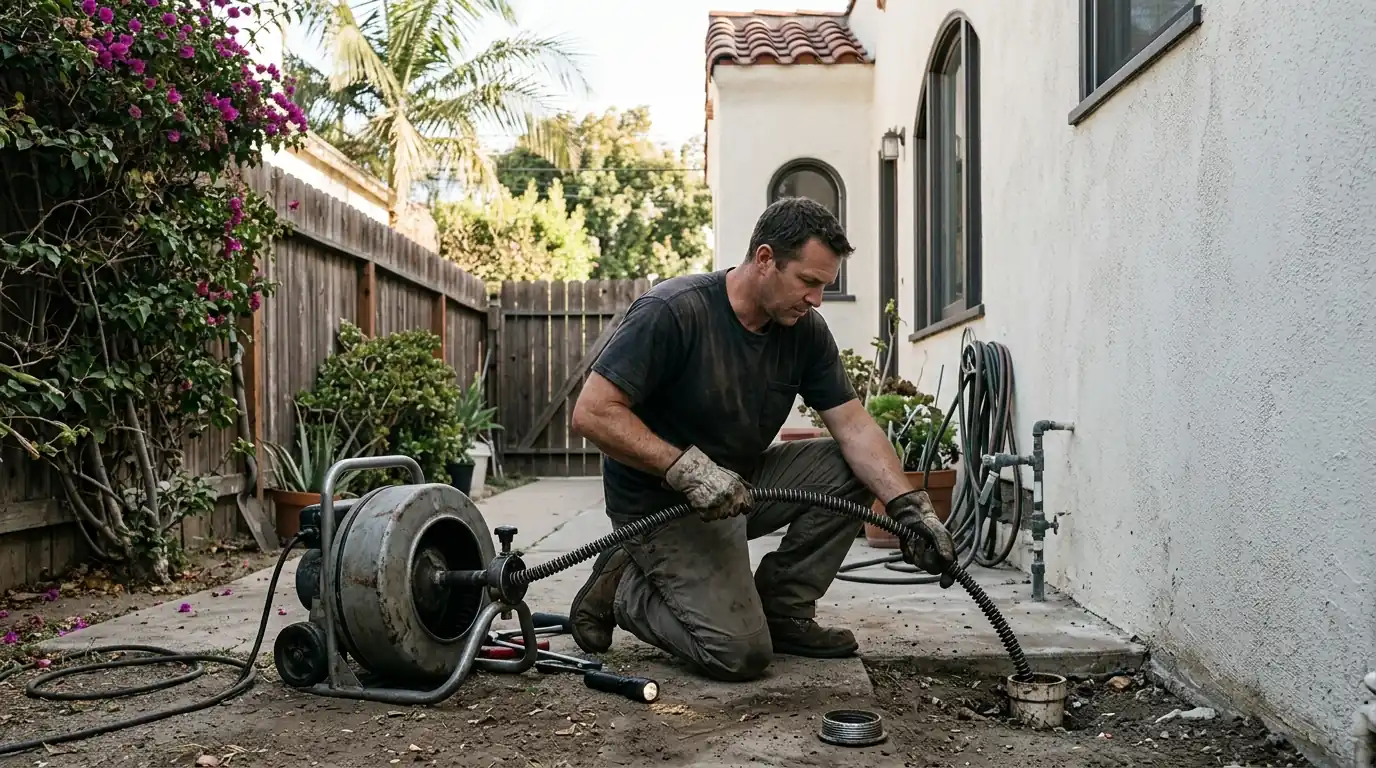
Sewer line repair fixes a damaged section of the pipe that carries waste from your house to the city main. We run a camera to find the crack, offset joint, root intrusion or sag, mark it from the surface, then replace that section by digging or line it from inside. You need it when clogs keep returning after cleaning.
Warning signs
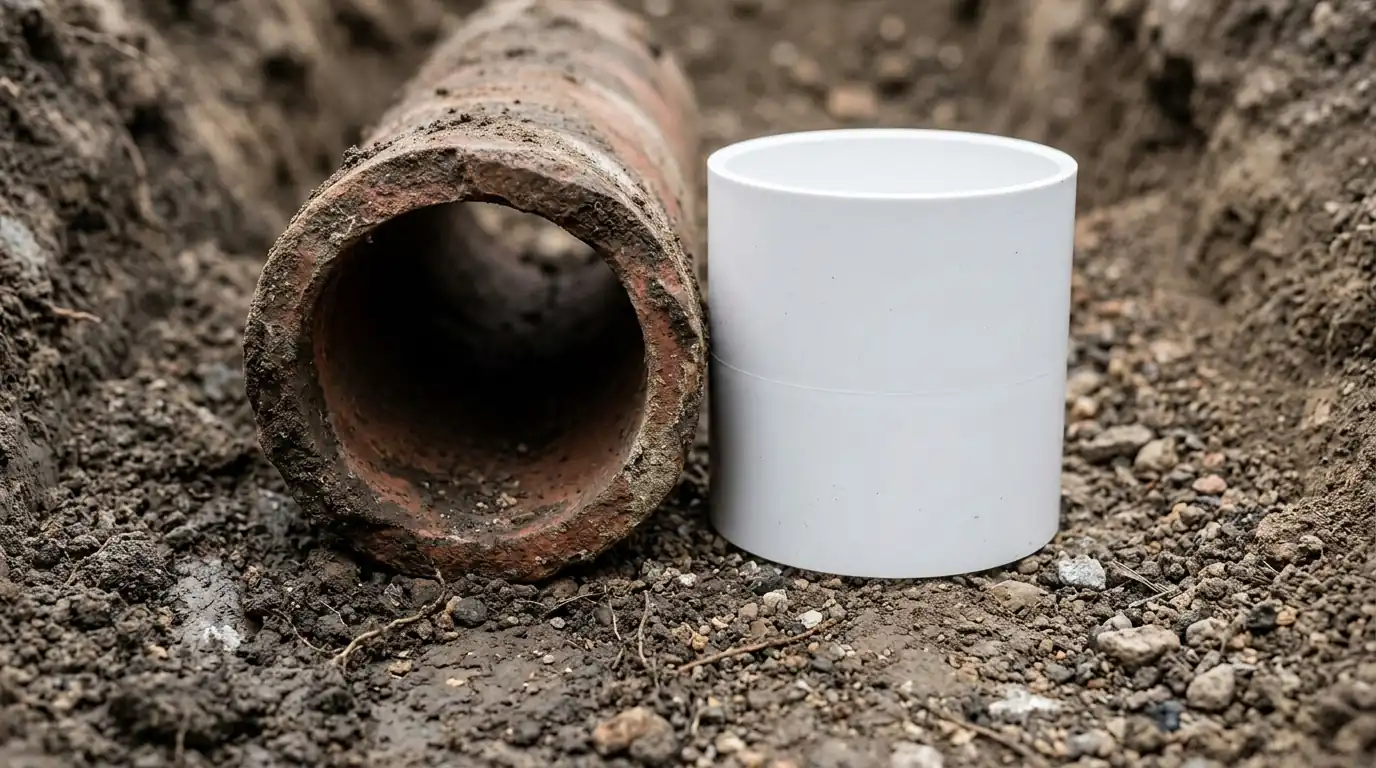
Most houses built before about 1970 in Los Angeles drain through vitrified clay or cast iron. Clay comes in short sections joined with mortar or early rubber gaskets, and each joint is a place where roots can find moisture. Once a hair-thin root gets in, it thickens every year and pries the joint apart. Our article on how roots get into clay sewer pipe walks through that process.
Cast iron fails differently. It rusts from the inside, the bottom of the pipe thins along the flow line, and eventually a channel opens where waste seeps into the soil. On camera this shows up as a rough, scaly bottom with flaking walls and sometimes a hole you can see straight through.
Ground movement adds a third problem. A belly, or sag, forms when soil settles under a section and water pools there. Paper and grease settle in the low spot, so you get recurring clogs even with no crack at all. Offset joints, where one section has dropped relative to the next, catch debris the same way.
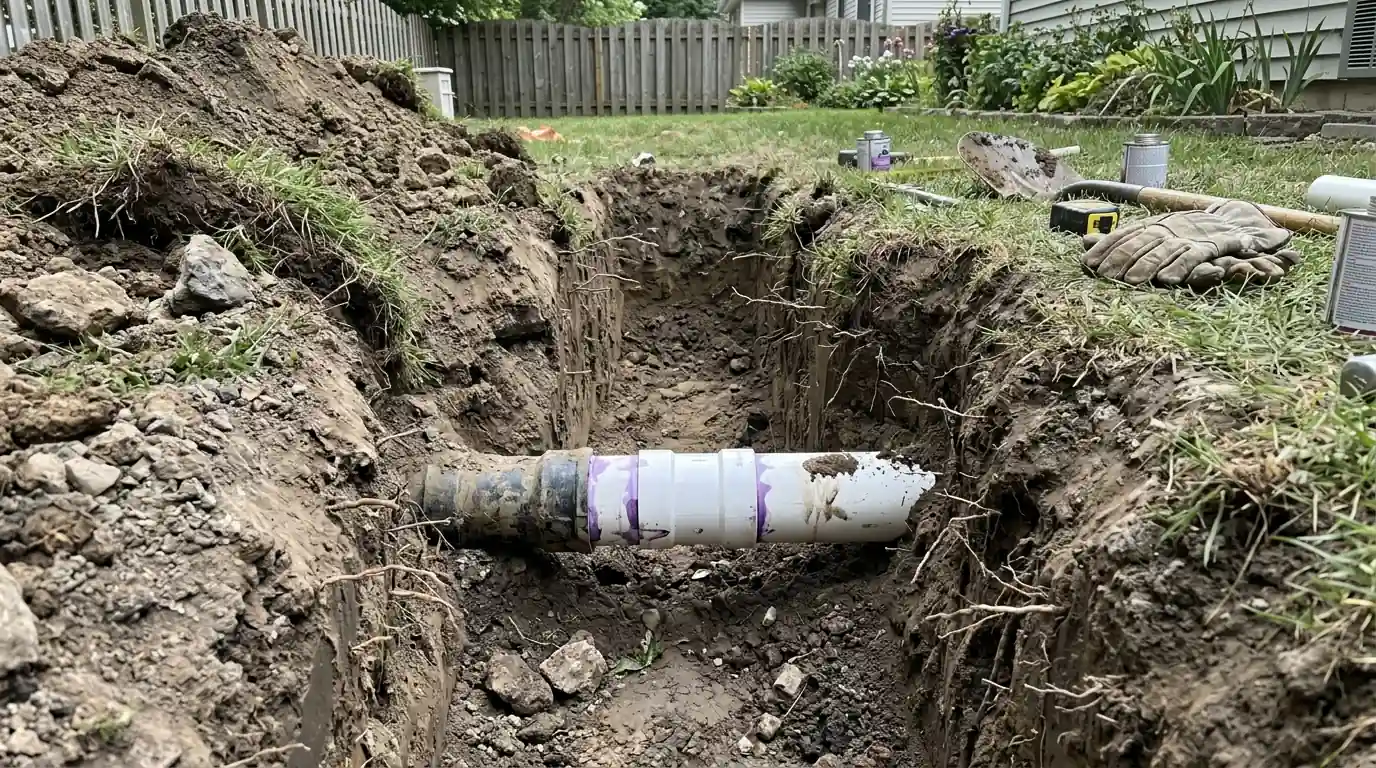
A single broken joint ten feet from the house does not justify replacing eighty feet of pipe. If the camera shows one bad spot and the rest of the line has a clean, round bore, we dig at that point, cut out the damaged section and splice in new PVC with shielded couplings.
The math changes when the camera shows breaks every few joints, heavy scale along the length or more than one belly. Patching three or four holes in a failing clay line often costs close to a full replacement and leaves the rest waiting to fail. In that case we show you the footage and price a trenchless replacement next to the repair.
When the damage sits under concrete, a mature tree or a finished room addition, digging is the expensive part. A sectional liner is a short sleeve of fiberglass or felt soaked in resin, pulled into place through the cleanout and inflated against the old pipe wall. Once it cures, it bridges the crack and seals out roots for that stretch.
Liners need a pipe that still holds its shape. A clay line that has collapsed or a cast iron pipe with its bottom gone has nothing for the sleeve to press against, so those spots get excavated instead. Before lining, we clear the line with a cutter or high-pressure water jetting so the resin bonds to clean pipe.
If sewage is coming up into a tub or floor drain, stop running water everywhere in the house. That means no laundry, no dishwasher, no showers, and asking everyone not to flush. Every gallon you send down ends up at the lowest opening.
Find your cleanout if you can. In many Los Angeles houses it is a capped pipe near the foundation on the street side, sometimes buried under mulch or a planter. If there is none at all, we can add one during the repair, which makes every future cleaning faster; see adding a two-way cleanout for how that works.
On the job
We run a recorded camera inspection from the cleanout to the city main and note the distance to every defect.
A transmitter on the camera head lets us mark the exact spot and depth on your lawn or driveway, so we dig one hole instead of guessing.
You watch the footage with us and get a price for a spot fix, a liner or a replacement, depending on what the pipe shows.
Sewer work in the City of Los Angeles goes through LADBS, while other cities use their own building departments. We handle the paperwork.
We excavate and splice in new pipe or install the liner, then backfill and compact the trench in layers so it does not settle.
A second camera pass confirms the repaired section is round, sealed and draining before we close up and clean the site.
Clay and cast iron laterals are common under pre-1970s houses across Los Angeles, from Valley tract homes to the older neighborhoods around downtown. Mature ficus, sycamore and eucalyptus trees along parkways send roots straight into those clay joints, a familiar story on the older streets of Reseda. In parts of the San Fernando Valley, expansive clay soil swells and shrinks with the seasons, which pulls joints apart and creates bellies. Hillside lots add steep runs and tight access for equipment. Many laterals also cross the parkway, which can mean an extra permit for work in the public right-of-way, depending on the city.
Typical pricing
Depth, what sits on top of the pipe and whether the inspector needs a test all move the price. A shallow dig in a lawn costs far less than cutting a driveway.
| Job | Typical LA range |
|---|---|
| Camera inspection with locating | $250 to $550 |
| Spot repair, one section dug in soil | $1,800 to $4,500 |
| Spot repair under concrete or at depth | $3,500 to $8,000 |
| Sectional liner, one damaged stretch | $2,500 to $5,500 |
| Belly correction, re-pitched run | $4,000 to $9,000 |
These are typical ranges, not a quote; depth, concrete, tree roots, permit requirements and street access all change the final number. See every job in our LA price guide.
Questions we hear
The camera decides it. If the footage shows one or two problem joints and the rest of the pipe has a smooth, round bore with little scale, a spot repair makes sense. If defects show up every few feet, repairs become a recurring bill, and replacement usually costs less over time. We show you the recording so you can judge it yourself.
In most of the region, the homeowner owns the lateral from the house to the connection at the city main, including the stretch under the parkway. The city typically takes over at the main itself. Rules vary by city, so if a break sits close to the street we confirm who owns that section before any digging starts.
Roots return where joints are still open. A new section of PVC with solvent-welded or gasketed joints, or a cured liner, gives roots nothing to enter in the repaired stretch. Untouched clay elsewhere on the line can still take on roots, so we point out any joints that look like the next weak spot and note them on the footage.
Light use is usually fine if the line drains slowly and nothing is backing up. Once wastewater comes up at a floor drain or tub, stop using water until the line is cleared. We can often open a path the same visit so the house is usable while the repair is scheduled and permitted.
Coverage
These are the communities that call us for this most often, with their main ZIP codes. The same 24/7 line covers every one of our 68 service areas.
Often booked together
A waterproof camera run through your sewer lateral to show cracks, roots, bellies and offsets on video, with depth and location marked before any digging is planned.
See the detailsMain sewer line clearing from the cleanout with heavy cable machines and root cutters, for backups that hit the lowest drains in the house at the same time.
See the detailsA failing sewer lateral replaced end to end by pipe bursting or a cured-in-place liner, working from two small pits and leaving driveways and trees in place.
See the detailsHigh-pressure water jetting that scours grease, scale, sludge and fine roots off the pipe wall, for lines that keep clogging after a cable has gone through.
See the detailsCall the line any hour. A plumber answers, asks what you are seeing and tells you what happens next.