Sewer Line Repair
Broken, bellied or root-choked sewer laterals repaired by spot excavation or sectional liner, after a camera shows exactly where the failure sits.
See the detailsRepairs & emergencies
Emergency PlumbingLeak DetectionSlab Leak RepairBurst Pipe RepairToilet RepairFaucet RepairGarbage Disposal RepairShower Valve RepairPressure Regulator ReplacementOutdoor Spigot RepairDrains & sewer
Drain CleaningMain Line Clog ClearingHydro JettingSewer Camera InspectionSewer Line RepairTrenchless Sewer ReplacementSewer Cleanout InstallationStorm & Yard Drain CleaningWater heaters
Water Heater RepairWater Heater ReplacementTankless Water Heater InstallationTankless Water Heater ServiceHeat Pump Water Heater InstallationWater Heater Earthquake StrappingHot Water Recirculation PumpPipes, gas & water lines
Whole-House RepipingMain Water Line ReplacementShutoff Valve ReplacementGas Line RepairGas Line InstallationSeismic Gas Shutoff ValveBackflow TestingWater Softener InstallationWhole-House Water FiltrationFixtures, remodels & property
Toilet InstallationFaucet & Sink InstallationKitchen PlumbingBathroom Remodel PlumbingADU PlumbingPlumbing InspectionApartment Building PlumbingCommercial PlumbingGrease Trap ServiceCity of Los Angeles
Los AngelesResedaWinnetkaCanoga ParkWest HillsTarzanaChatsworthPorter RanchGranada HillsNorth HillsLake BalboaPanorama CityValley GlenSun ValleyPacoimaSylmarSunland-TujungaSan PedroWilmingtonMission HillsValley VillageHarbor CityLA and Ventura county cities
Santa ClaritaSan FernandoBurbankGlendalePasadenaCalabasasThousand OaksSimi ValleySanta MonicaInglewoodHawthorneTorranceCarsonLong BeachComptonMore LA County cities
DowneyNorwalkLakewoodEl MonteWest CovinaWhittierPomonaAlhambraArcadiaCovinaBeverly HillsCulver CityRedondo BeachBellflowerSouth GateOrange County and Inland Empire
AnaheimSanta AnaIrvineHuntington BeachOrangeFullertonGarden GroveCosta MesaRancho CucamongaOntarioCoronaCounties
Los Angeles CountyVentura CountyOrange CountySan Bernardino CountyRiverside CountyWhen the camera shows a sewer line that is cracked, root-filled or rusted along most of its length, patching stops making sense. Trenchless replacement swaps the whole run while your driveway and landscaping stay put.
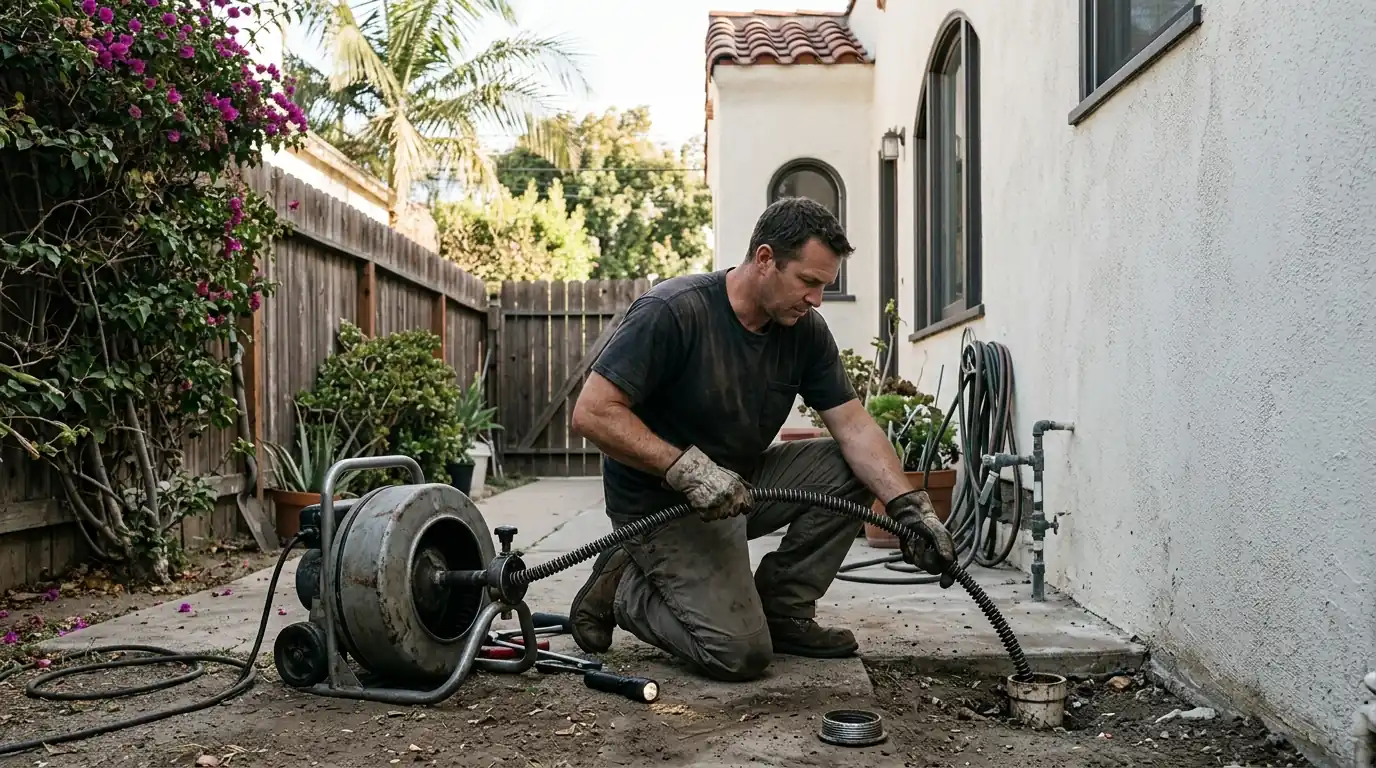
Trenchless sewer replacement installs a new sewer lateral without digging a trench along its full length. We either pull a new HDPE pipe through the old one while a bursting head splits the old pipe outward, or we cure a resin liner inside the old pipe. Two small access pits replace a long trench. You need it when damage runs the length of the line.
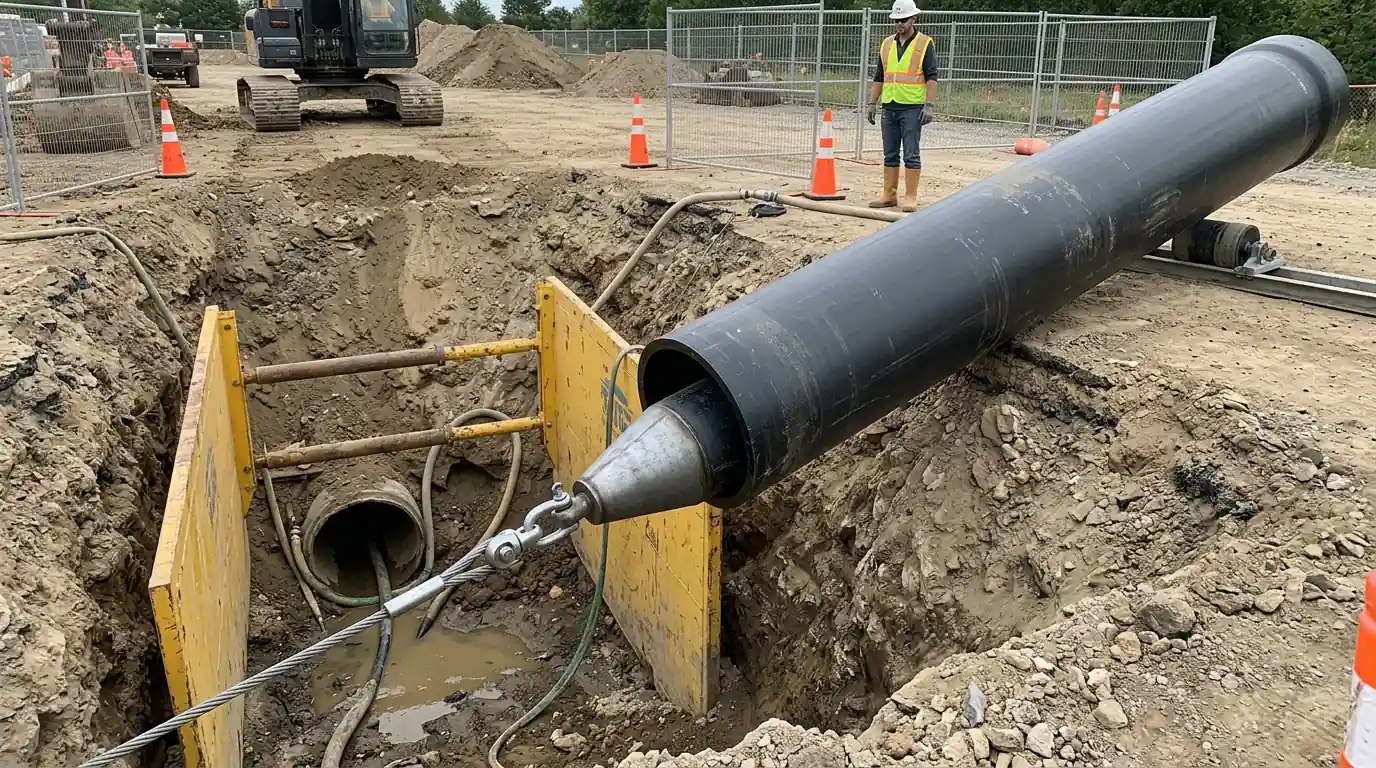
Pipe bursting replaces the old pipe with a brand new one. We open a pit near the house and another near the property line, feed a steel cable through the old line, and pull a cone-shaped bursting head back through it. The head fractures clay or cast iron outward into the soil while a continuous length of fused HDPE pipe follows right behind. The result is a jointless pipe the same size as the original or one size larger.
A cured-in-place liner builds a new pipe inside the old one. A felt or fiberglass tube soaked in epoxy is inverted into the cleaned host pipe and held against the walls with air or water pressure until it hardens. It suits lines where bursting is risky, such as pipes running close to a foundation footing, a gas line or a neighbor's wall, and lines with several bends.
Neither method fixes a pipe with the wrong slope. If the camera shows a long belly, we may combine trenchless work with a short open dig to correct the grade in that stretch.
The main reason people choose trenchless in Los Angeles is what sits on top of the pipe. Many laterals run under a driveway, a front walk, a mature parkway tree or a lawn with irrigation lines and plantings. A conventional replacement would cut all of that in a straight line to the street.
With bursting, the disturbance is two pits, each a few feet square. Lining can sometimes be done from an existing cleanout with no pit at all. Concrete is cut only where a pit lands, and roots near the line are cut flush rather than the tree being disturbed.
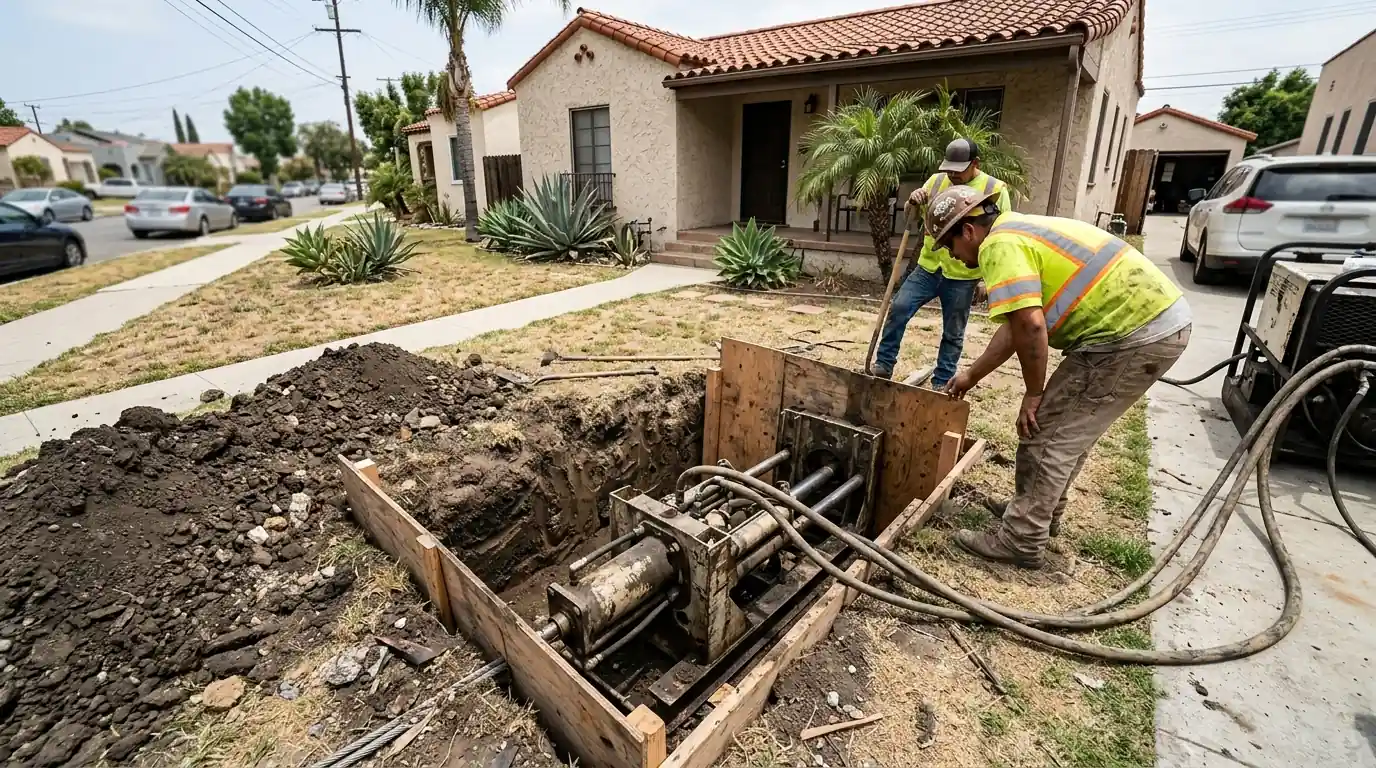
Bursting needs room for the old pipe to break outward. Lines that run within a few inches of another utility, or under a slab that could crack from the expansion, are better lined or dug. We check depth and nearby lines before choosing a method, and we request underground utility marking so gas and water lines are located first.
A line that has fully collapsed in several places can stop a liner from going in, and a fully crushed section can stop a bursting head. Severe offsets from ground movement sometimes need an open dig at that point. In those cases we explain why and price a hybrid: trenchless for most of the run plus a short open section where the pipe is too far gone. If only one spot is bad, a targeted sewer repair is usually the cheaper answer.
The new pipe has to tie into something at each end. At the house, we connect to the building drain at or just outside the foundation, and this is the best moment to add a two-way cleanout so future cleaning never needs a ladder on the roof vent. At the street end, the new line joins the existing lateral near the property line or at the city sewer connection, depending on where the damage stops.
If the old lateral carries waste from an ADU or a garage conversion as well, we size the new pipe for that combined load. Planning the backyard unit's drain now avoids a second dig later, which our guide to ADU plumbing planning covers in more detail.
Warning signs
Typical pricing
Line length, depth, the number of bends and whether pits land in soil or concrete drive the price. Permits and any city inspection fees are added on top.
| Job | Typical LA range |
|---|---|
| Pipe bursting, 40 to 60 feet of lateral | $7,000 to $14,000 |
| Pipe bursting, 60 to 100 feet of lateral | $11,000 to $20,000 |
| Full-length cured-in-place liner | $8,000 to $18,000 |
| Hybrid with one open-dig section | $10,000 to $22,000 |
These are typical ranges, not a quote; depth, concrete, bends, access for equipment and work in the public right-of-way all change the price. See every job in our LA price guide.
On the job
We record a camera survey of the full line, mark the depth at intervals and note bends, branch connections and any nearby utilities.
Based on the footage, we recommend bursting, lining or a hybrid, and show you exactly where pits would go.
We file the permit with LADBS or your city's building department and request underground utility marking before any digging.
For lining, the host pipe is cleaned with cutters and jetting. For bursting, the access pits are dug and the cable is fed through.
The bursting head pulls new HDPE through, or the liner is inverted and cured. Most homes are back on their drains the same day or the next.
A final camera pass confirms a clean, continuous pipe. We backfill the pits, compact the soil and patch any cut concrete.
A lot of Los Angeles houses sit on narrow lots with a driveway running right over the sewer lateral, so trenchless methods often save thousands in concrete work alone. Hillside homes in neighborhoods like Sunland-Tujunga can have steep, deep runs where an open trench would need shoring. Older clay laterals are widespread under pre-1970s housing, and parkway trees push roots into many of them. Street parking for the equipment trailer matters too, so we plan where it sits before the day of the job. Work that reaches the public right-of-way may need a separate street permit from the city.
Questions we hear
Most single-family laterals are done in one to two days on site. The first part of the day goes to pits and preparation, and the pull or cure happens once everything is ready. Permit timing and inspection scheduling usually add more calendar time than the work itself, so we plan around those dates with you.
Usually yes. For bursting, roots barely matter because the head splits the clay and the new pipe follows. For lining, we cut the roots out first so the liner seats against clean pipe. If the camera shows a section where clay has fully collapsed, we may open a small pit there before pulling the new line through.
Bursting keeps the same diameter or upsizes it, since the new HDPE pipe follows the head through the fractured old line. A liner reduces the inside diameter slightly because it adds a thin wall inside the old pipe. The smooth surface usually offsets that small loss, so flow capacity stays about the same for a house.
Lining works well under slabs because it needs no digging along the run and does not push outward. Bursting under a slab is riskier, since the expanding fragments can stress the concrete. For lines under the house we usually recommend a liner from a cleanout, and bursting only for the yard portion out to the street.
Coverage
These are the communities that call us for this most often, with their main ZIP codes. The same 24/7 line covers every one of our 68 service areas.
Often booked together
Broken, bellied or root-choked sewer laterals repaired by spot excavation or sectional liner, after a camera shows exactly where the failure sits.
See the detailsA waterproof camera run through your sewer lateral to show cracks, roots, bellies and offsets on video, with depth and location marked before any digging is planned.
See the detailsA two-way sewer cleanout added outside the house so the main line can be cleared, inspected and repaired without pulling toilets or climbing onto the roof.
See the detailsMain sewer line clearing from the cleanout with heavy cable machines and root cutters, for backups that hit the lowest drains in the house at the same time.
See the detailsCall the line any hour. A plumber answers, asks what you are seeing and tells you what happens next.