Quick answer
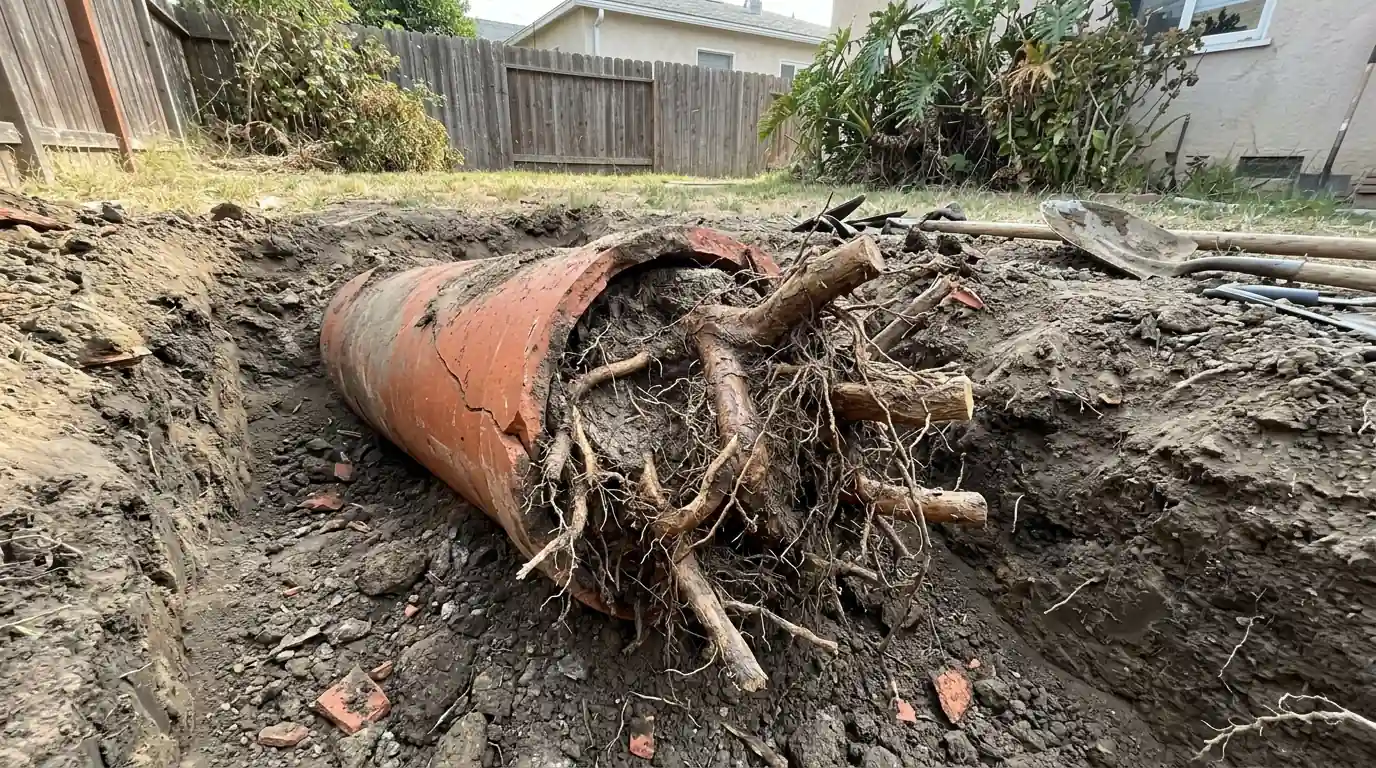
Clay sewer laterals are laid in short sections joined at bell joints that loosen and crack with age. Tree roots find the moisture at those joints and grow inside, catching paper and grease until the line backs up. Cable cleaning and hydro jetting clear roots for a while. Lasting fixes are spot repairs, lining or trenchless replacement, chosen after a camera inspection.
How clay sewer laterals were built
The lateral is the private sewer pipe that carries everything from your house to the public main, usually out under the street. In older Los Angeles neighborhoods it was most often laid in vitrified clay, a fired ceramic pipe that never rusts and stands up well to sewage.
Clay comes in short lengths of a few feet, and each length has a bell end that the next pipe slides into. Older joints were sealed with mortar or a tar compound that turns brittle. Later clay used rubber gaskets. Either way, a long lateral has a great many joints, and each one is a weak point.
Ground movement adds to the wear. Earthquakes, settling backfill and heavy trucks on the street nudge sections out of line. Once a joint opens even slightly, water and sewer vapor escape into the soil, and roots follow them back in.
Why LA trees go after sewer lines
Roots grow toward moisture and nutrients, and a weeping sewer joint offers both in a dry climate. Through long dry months, the damp soil around a cracked lateral draws fine root hairs straight to the joint. Once inside, they branch into a mat that fills the pipe.
Ficus, sycamore and eucalyptus line streets across the region and root aggressively. Parkway trees often stand right over the lateral's path to the street, which is why so many root problems sit between the sidewalk and the main. We see it constantly on the older blocks of Valley Glen and San Pedro, where big trees and original clay laterals share the same strip of ground.
Taking out the tree is rarely practical, and a city parkway tree generally cannot be removed without permission. It would not fix the open joint anyway. The repair has to happen in the pipe.
Warning signs of roots in a clay sewer line
A single slow sink is usually a local clog. Root problems show up across the whole house because they choke the main line that every fixture drains into. Backups that return on a rough yearly cycle are a strong hint, since roots regrow after a cable cuts them.
If there is a cleanout near the house, loosen the cap slowly. Standing water inside the cleanout means the blockage is downstream, somewhere between that point and the street.
Heavy rain can make a root clog look worse than it is. In older neighborhoods, groundwater seeps into cracked clay joints during storms and adds flow the narrowed pipe cannot carry. If backups at your house line up with wet weather, mention it when you call, because it points straight at open joints.
- Several fixtures draining slowly at once
- A toilet that gurgles when the tub or washer drains
- Sewage coming up in the lowest drain, often a shower
- Backups that come back months after a cleaning
- A strip of unusually green lawn over the sewer path
- Sewer odor near the cleanout or the front yard
Clearing roots: cable, jetting and what each buys you
A cable machine with a cutting head chews through the root mass and gets the line flowing again. It is quick and works well as a first response when you need a main line backup cleared tonight. Roots that are cut but left in place grow back thicker, so expect a return visit.
High pressure jetting scours the inside of the pipe wall and flushes out root fragments, grease and scale. It cleans more thoroughly than a cable and leaves the pipe ready for a clear camera view. Jetting is not a cure either, but it stretches the time between backups.
Root killing products poured through a toilet can slow regrowth when used as directed. They do nothing about the cracked joint that invited the roots, so treat them as upkeep, not a fix.
Seeing inside the pipe before you decide
Any lasting repair decision should start with a camera run through the lateral. We push a waterproof camera from the cleanout to the public main and record the whole trip. The footage shows each joint, any offset or crack, root intrusion, low spots that hold water, and how far each problem sits from the house.
Ask for the recording and for the bad sections to be located and marked on the ground. That footage matters when buying a home too, since a clay lateral under a 1950s house can hide a large repair that a general home inspection never looks at.
If the house has no cleanout, adding one near the foundation makes every later cleaning and camera trip faster and cheaper.
Repair choices for a root damaged clay line
When the camera finds one or two bad joints in otherwise sound pipe, a spot repair cuts out those sections and replaces them with ABS or PVC and shielded couplings. Digging depth, and whether the bad joint sits under a driveway or the parkway, drive the price.
When roots and cracks run through most of the line, trenchless replacement makes more sense. Pipe bursting pulls new HDPE pipe through the old path while breaking the clay apart, and lining cures a resin sleeve inside the old pipe. Both close every joint, which removes the gaps roots need. Inside the City of Los Angeles, the work on private property is permitted through LADBS, other cities use their own building departments, and digging in the street needs a separate city permit.
Typical ranges, not a quote, in Los Angeles: root cutting with a cable runs about $250 to $550, hydro jetting $450 to $900, a camera inspection $200 to $450, a single point repair $2,500 to $6,000, and trenchless replacement of a full lateral roughly $8,000 to $20,000 depending on length, depth and street work.
Keeping roots out after the line is fixed
A repaired or replaced lateral with tight joints gives roots nothing to enter, but the line still needs some care. Keep grease, wipes and paper towels out of the drains, since a buildup of those in a new pipe draws the same complaints as roots in an old one.
When you plant new trees, keep large rooting species well away from the sewer path and the cleanout. A quick camera check every few years on a line that was spot repaired, rather than fully replaced, catches new root growth at the remaining clay joints while it is still thin and easy to cut.