Quick answer
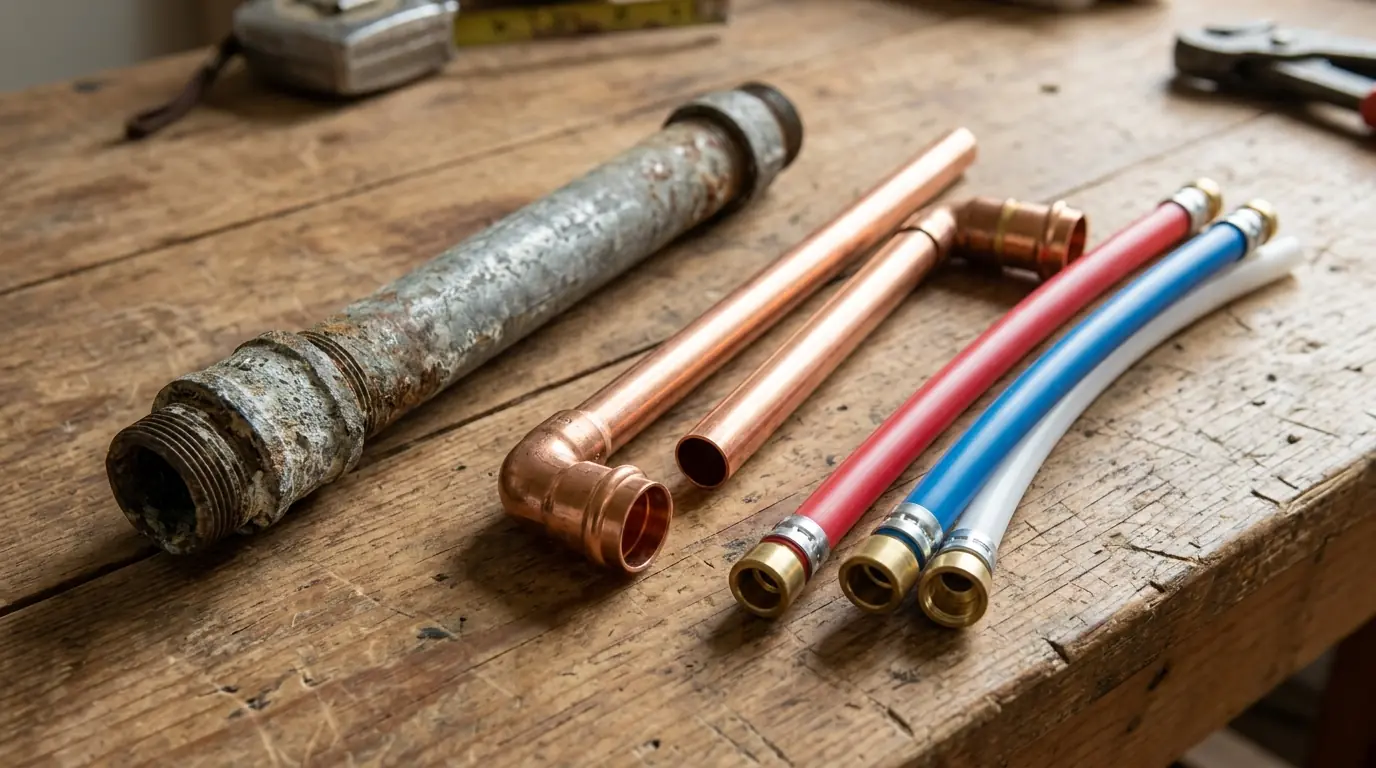
Galvanized pipe rusts from the inside, which narrows the bore and eventually leaks at threaded joints. A patch makes sense for one leak in a system that still flows well. A partial repipe fits when one area, like the main line or a single bathroom, is the problem. A full repipe is the lasting answer when pressure is poor everywhere and leaks keep coming.
How to tell if your house has galvanized pipe
Start where the main line enters the house, often at a hose bib near the front wall or at the water heater. Galvanized pipe is dull gray steel with threaded fittings. Scratch it with a key and it shows silver, and a magnet sticks to it firmly. Copper scratches to a penny color, and a magnet will not stick at all.
Many Los Angeles homes have a mix of materials. A past owner may have changed the main to copper, or replaced the lines in a remodeled kitchen, leaving galvanized everywhere else. Look under sinks, at the water heater and in the crawlspace if there is one, and note where the material changes.
Raised foundation houses in older neighborhoods like Sunland-Tujunga and San Pedro, and in parts of Pasadena, often have galvanized lines you can see from the crawlspace. That makes both the check and any later repipe simpler.
What happens inside old galvanized lines
The zinc coating on galvanized steel wears away over the decades. Once it is gone, the steel rusts from the inside and grows a rough crust of corrosion that narrows the pipe. Hard water adds mineral deposits on top. At the worst spots, a half inch line can close down to an opening not much wider than a pencil.
Threaded joints are the weak points. Cutting threads removes part of the pipe wall, leaving thinner metal right where rust works hardest. That is why leaks on galvanized systems tend to start at fittings, short nipples and the spots where pipe meets a valve.
Rust shows up in the water too. Brown or yellow water after the house sits unused, especially on the hot side, points to corroded galvanized lines or a rusting water heater.
Signs it is more than a one time leak
No single sign settles the question. Low pressure across the whole house can also come from a failing pressure regulator at the main, which costs far less to fix, so we rule that out first.
A pressure gauge threaded onto a hose bib shows static pressure. Open a tub faucet while you watch the gauge and see how far it falls. A big drop with good static pressure points to restricted pipe rather than a regulator problem.
Pay attention to which taps suffer most. Fixtures at the far end of the house, or on the upper floor of a two-story home, usually show restriction first because water has to travel through the most corroded pipe to reach them. If only one bathroom is weak, a partial fix may cover it.
- Weak flow at several fixtures, worse when two run at once
- Brown water after a trip or first thing in the morning
- Leaks at threaded fittings, especially near valves
- Aerators that clog with rust flakes
- A shower that drops off when someone flushes a toilet
When patching galvanized pipe is reasonable
A patch replaces the leaking section and its fitting with copper or PEX, joined to the old steel with a dielectric or brass transition fitting. It costs the least and is a fair choice when pressure is still decent, the leak is isolated, and you plan to repipe within a few years anyway.
The risk is that disturbing old galvanized often starts the next leak. Putting a wrench on a corroded fitting can crack the pipe on the far side of it. Our plumber will tell you plainly when the pipe around a leak looks too far gone to hold a patch.
When we do patch, we replace back to a sound fitting rather than splicing into the middle of a rusted run. That usually means cutting out a little more pipe than the leak itself, but it puts the new joints on metal that can still hold threads or a compression fitting.
Partial repipe: main line, one zone or one bathroom
The line from the meter to the house is often the worst run, because it carries all the flow and sits in damp soil. Replacing just that stretch in copper or PEX, a new main water line, can bring back noticeable pressure when the lines inside are in better shape.
A partial repipe also fits well during a remodel. With a kitchen or bathroom open to the studs, replacing those branch lines costs much less than it will later. Keep in mind that partial work leaves old galvanized feeding the new pipe, so rust flakes and restriction upstream can still reach the new fixtures.
Partial work also helps when budget is tight. Some owners replace the main first, then the hot lines, which rust faster than cold because heat speeds corrosion, and finish the cold side a year or two later. Planning the stages up front keeps each phase from being redone when the next one starts.
Full repipe: what it involves and what it costs
A whole-house repipe replaces every supply line from the main to each fixture. In most LA homes we run PEX or copper through the attic or crawlspace and drop lines into the walls, cutting small openings at each fixture rather than tearing out whole walls. Water is usually back on at the end of each work day. Before any repipe we turn off the main, protect floors and furniture along the work path, and mark each opening on the walls so you can see exactly where access will be. Old galvanized lines are usually cut and left in place inside walls, since pulling them out would mean opening far more drywall or plaster.
PEX costs less, needs fewer joints and tolerates a little ground movement. Copper is rigid and long-lived, and some owners and buyers prefer it. Either way, a repipe in the City of Los Angeles needs a permit through LADBS, other cities issue permits through their own building departments, and an inspection happens before walls are closed.
Typical ranges, not a quote, in Los Angeles: patching a single galvanized leak runs about $300 to $800, replacing the main from meter to house $2,000 to $5,500, and a full repipe of a two bathroom single story house roughly $6,000 to $15,000 in PEX, more in copper. Drywall patching and paint are often priced separately.