Quick answer
Hard water in Los Angeles leaves calcium and magnesium scale inside faucets, shower valves, tank water heaters and tankless units. You notice it as crusty spouts, weak flow, a noisy tank and tankless error codes. Regular flushing and descaling slow the damage, and a water softener or conditioner reduces it at the source for the whole house.
Why so much Los Angeles water is hard
Most of the water serving the region is imported. Much of it comes from the Colorado River and from the State Water Project in Northern California, and the Colorado River supply picks up a heavy mineral load on its way here. Groundwater pumped in some local basins is hard as well.
Hardness shifts by neighborhood and by season, because water agencies blend their sources differently through the year. LADWP serves the City of Los Angeles, while cities like Burbank and Glendale run their own water departments. Each agency publishes a yearly water quality report that lists hardness, and that number is the best starting point for your house.
Hard water is safe to drink. The trouble is mechanical: the minerals drop out of solution when water is heated or left standing, and they build a rock-like scale one thin layer at a time.
Faucets, aerators and shower valves
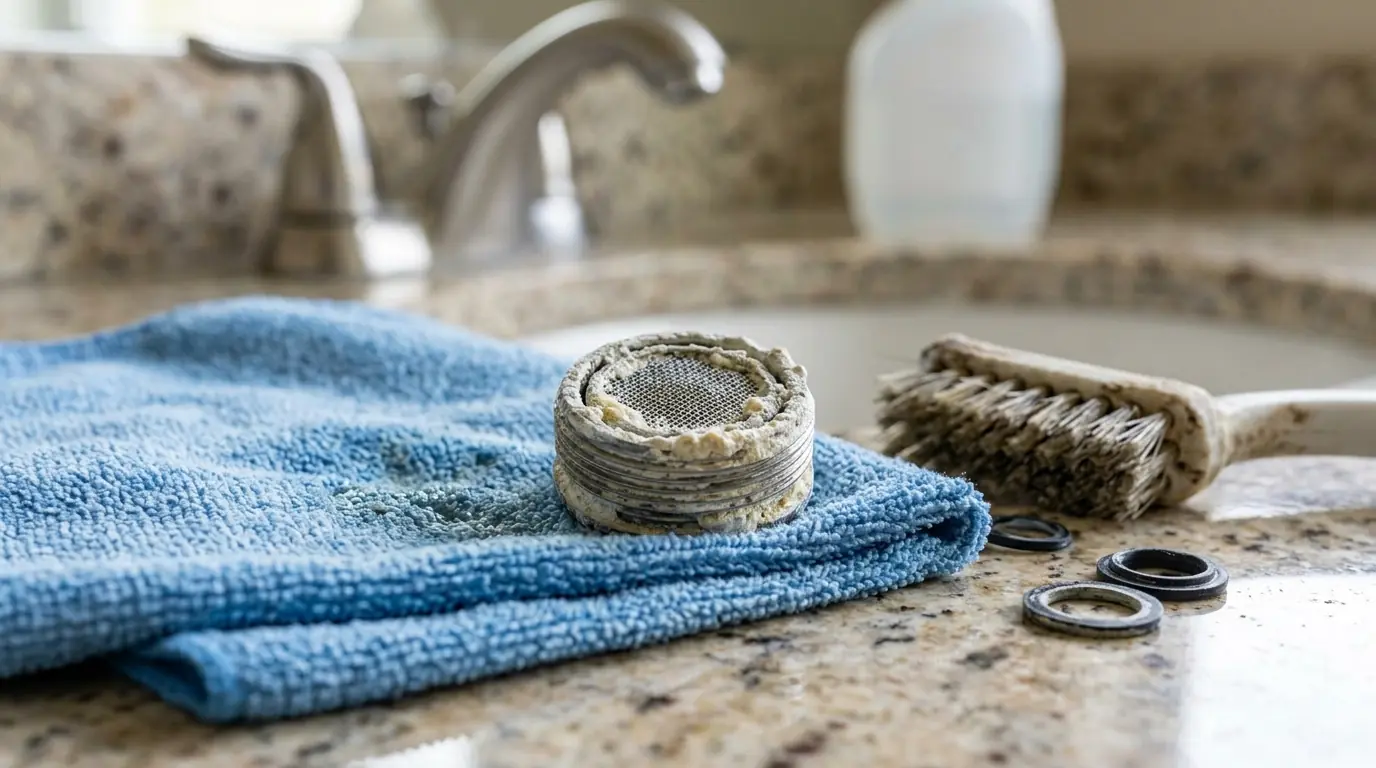
The first place most people see scale is the aerator, the small screen at the tip of the spout. Flow gets weaker or starts spraying off to one side. Unscrew the aerator, soak it in white vinegar for an hour, scrub it with an old toothbrush and put it back. That clears most of it.
Inside the faucet body, scale is harder on cartridges. A single handle faucet that turns stiffly, drips after you shut it or mixes temperatures unevenly usually has a scaled cartridge. Shower valves suffer the same way, and a pressure balancing cartridge that sticks can hit you with a burst of hot or cold. We swap those cartridges often on stuck or dripping shower valves across the Valley.
Toilets collect scale as well, though you rarely see it. Mineral buildup on the fill valve makes it hiss or refill slowly, and crust on the flapper seat lets water seep into the bowl so the tank refills on its own during the night. A ghost refill every hour or so is often a scaled flapper seat rather than a broken part.
- White or tan crust around spouts and shower heads
- Spray that splits or angles away from center
- Handles that turn stiffly or stick partway
- Drips that come back soon after a washer or cartridge change
- Spots on glass shower doors that will not wipe off
What scale does inside a tank water heater
In a tank heater, scale falls to the bottom as sediment. On a gas model, that layer sits between the burner flame and the water, so the tank takes longer to heat and the steel bottom runs hotter than it should. The popping or rumbling you hear is water trapped under the sediment flashing to steam.
Electric tanks show it differently. Scale coats the lower heating element until it burns out, and sediment plugs the drain valve. That is why so many people try to flush a heater for the first time after years and get only a trickle.
Flushing once a year keeps the sediment layer thin. On a heater that is well past ten years old and loud, flushing can loosen a crust that then jams the drain valve open or makes it leak. At that point it is often wiser to plan for replacing the tank on your own schedule.
Tankless units and hard water
Tankless heaters are more sensitive to scale than tanks. Water passes through a narrow heat exchanger at high temperature, and minerals plate out inside those small passages. As the coating thickens, the unit runs hotter, throws error codes and eventually shuts itself down to avoid damage.
Manufacturers call for periodic descaling, done by circulating a mild acid solution through the unit with a small pump hooked to its isolation valves. In much of Los Angeles, once a year is a reasonable rhythm, and harder water may need it sooner. Our tankless service visits include the descale, a cleaning of the inlet screen and a check of the venting.
If your unit was installed without isolation valves, descaling becomes awkward and messy. Adding a valve kit is a short job, and it pays for itself the first time the unit needs service.
Softeners, conditioners and filters: what each one does
A salt-based water softener swaps calcium and magnesium for sodium through ion exchange. It is the only option that actually removes hardness, so it protects every fixture downstream. It needs a drain, an outlet and regular salt, and some Southern California agencies restrict softeners that send brine to the sewer, so check local rules first.
Salt-free conditioners use a media that changes how minerals crystallize so they are less likely to stick to surfaces. They do not remove hardness, but they cut scale in heaters and need no salt or drain. Carbon filtration solves a different problem entirely: it removes chlorine and chloramine taste and odor, not minerals.
We set up softener and conditioning systems near the main where it enters the house, usually with a bypass so hose bibs and irrigation keep running on untreated water. If you are also choosing a new heater, our guide to tank, tankless and heat pump models covers how each one handles scale.
A simple upkeep plan for hard water homes
You do not need to treat everything at once. Start with the cheap habits that cost a few minutes, then decide whether whole-house treatment is worth it based on how fast scale returns.
Keep a simple log of when you clean each item and how bad it looked. If a shower head needs soaking every month instead of every season, or a tankless unit throws a scale code well before its yearly service, the water at your house is on the harder end, and treating it at the main starts to pay back faster.
Typical ranges, not a quote, in Los Angeles: a tankless descale and service runs about $200 to $400, a tank flush on its own about $125 to $250, and an installed whole-house softener roughly $1,800 to $4,500. Access at the main, the condition of old valves and how much new pipe the install needs all move those numbers.
- Every few months: soak aerators and shower heads in vinegar
- Once a year: flush the tank water heater
- Once a year or sooner: descale the tankless unit
- As needed: replace faucet cartridges that stiffen or drip