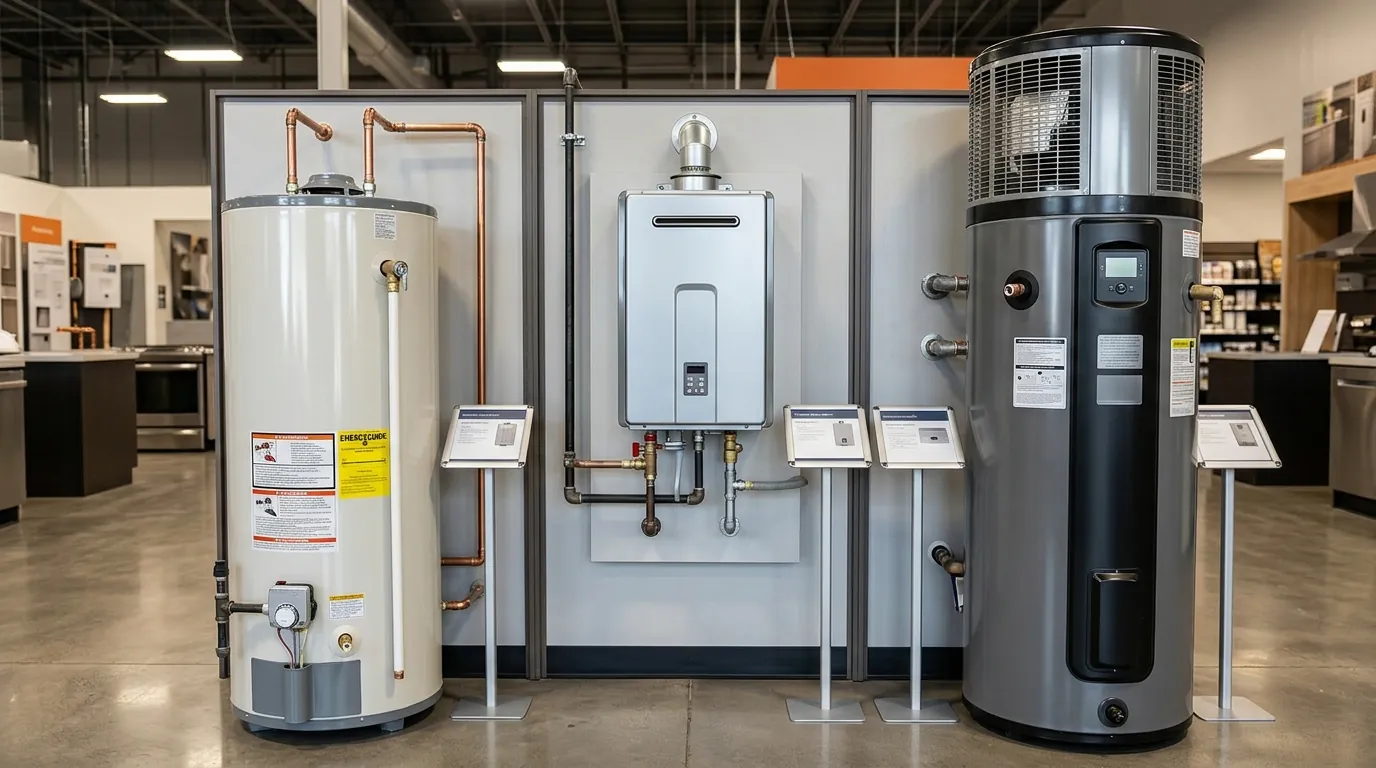
Quick answer
A standard tank is the cheapest to buy and the simplest to swap. Tankless gives continuous hot water but needs a larger gas supply and yearly descaling in LA's hard water. A heat pump tank uses far less energy and qualifies for state and utility incentives, but it needs airflow, space and an electrical circuit. Household size and location decide the rest.
Start with how your household uses hot water
Before comparing equipment, count the hot water moments that overlap. Two showers running at 7 a.m. while the dishwasher finishes is a very different load than a couple who shower at different times. Overlap decides tank size for storage heaters and gas size for tankless units, and it's where most wrong choices begin.
Then look at where the heater sits. In Valley tract homes it's usually in the garage or a closet off the service porch. Older hillside houses often tuck it into a cramped exterior closet, and condos sometimes stack it inside a hallway closet with little room around it. Location matters more for heat pump units than for anything else.
Finally, think about the next ten years. If you're planning an addition, a second bathroom or a move to an all-electric kitchen, buy for that house, not the one you have today.
Standard tank heaters: lowest cost, simplest swap
A 40 or 50 gallon gas tank is still what most LA houses have, and replacing it with the same type is the fastest, least expensive job. The venting, gas line and water connections are already in place, so a replacement often takes a few hours. Recovery is solid on gas, and there's no minimum flow needed before hot water starts.
The downsides are standby heat loss and a limited supply. Once the tank empties, you wait for it to reheat. Hard water also drops sediment on the bottom of the tank, which makes it rumble and shortens its life, so a yearly drain and flush pays off. Our article on what hard water does to LA fixtures shows how that scale builds over time.
Tankless: continuous hot water, with LA catches
A gas tankless heater fires only when a tap opens, so it never runs out and takes a fraction of the wall space. The catch is fuel. Most whole-house units draw close to 200,000 BTU per hour at full fire, which is often more than an older half-inch gas line can deliver alongside a furnace and range. Many installs need a larger line from the meter, and sometimes SoCalGas has to upgrade the meter itself.
Hard water is the other issue. Imported Colorado River and State Water Project supplies leave scale on the heat exchanger, and a scaled unit throws error codes and runs short on hot water. Plan on a vinegar flush through the isolation valves at least once a year. Yearly tankless descaling costs far less than a new heat exchanger, and a water softener cuts the buildup further.
Expect a short wait for hot water and a brief cold slug between back-to-back uses. A hot water recirculation pump solves the wait in long single-story ranch houses where the far bathroom sits a long way from the heater.
Heat pump water heaters: efficient, but they need air
A heat pump water heater pulls warmth from the surrounding air and moves it into the tank, using far less electricity than a standard electric element. California keeps pushing them through Title 24 energy rules and utility rebates, and LA's mild climate suits them better than most of the country. A garage is the ideal spot: plenty of air, and the cool exhaust bothers no one.
The limits are physical. The unit is taller than a gas tank, it needs a large volume of air around it or a louvered door and ducting in a closet, and it produces condensate that has to drain somewhere. Most models need a dedicated 240 volt circuit, though newer 120 volt plug-in versions can sometimes use an existing outlet. Recovery in heat pump mode is slower, so families with heavy overlap often size up to a 65 or 80 gallon tank.
Rebates change from year to year and depend on who supplies your power. LADWP customers and those in cities with their own power departments see different incentive lists, so check current offers before you buy.
Rules that apply to all three types
Every water heater tank in California needs earthquake bracing: two straps, one in the upper third of the tank and one in the lower third, anchored to studs or masonry. Tankless units mount to the wall and don't take tank straps, but their gas and water connections still need proper support. If you're keeping your current tank for now, our strap inspection guide shows what to look for.
Replacement and conversion work needs a permit, through LADBS in the City of Los Angeles or your own city's building department elsewhere. Going from tank to tankless often means new venting and a bigger gas line, and going from gas to heat pump means new electrical work, so the permit covers more than the heater.
Gas work comes with one rule for the household. If you ever smell gas around a heater, get everyone out and call SoCalGas or 911 once you're outside, before touching anything.
What each option typically costs in Los Angeles
These are typical installed ranges, not a quote. Venting changes, gas line runs, electrical panel capacity and permit fees move the final number more than the heater itself does.
When we price a replacement, we look at the gas line, the panel, the vent path and the drain options in the same visit, so the choice is made with real numbers. The details of a conversion are on our heat pump water heater installation page.
- Gas tank, 40 to 50 gallon, like for like: $1,800 to $3,500
- Gas tankless, whole house, with new venting: $4,000 to $7,500, plus $800 to $2,500 if the gas line needs upsizing
- Heat pump tank, 50 to 80 gallon: $4,000 to $7,000 before rebates
- New 240 volt circuit for a heat pump: $500 to $2,000 depending on panel space and distance