Quick answer
A seismic gas shutoff valve is a device on the house side of your gas meter that closes when strong shaking hits. It stops gas from feeding a broken line or appliance connector after a quake. The City of Los Angeles requires one on new construction and many remodels. If you ever smell gas, leave the building and call SoCalGas or 911 from outside first.
What the valve does and where it sits
Many fires after a big earthquake start with gas. Water heaters tip, flexible connectors pull apart, rigid pipe cracks at threaded joints, and a single spark finds the leak. The 1994 Northridge earthquake (magnitude 6.7, January 17, 1994) broke gas lines across the San Fernando Valley, and some of those breaks led to fires. A seismic valve is meant to stop that chain at the source.
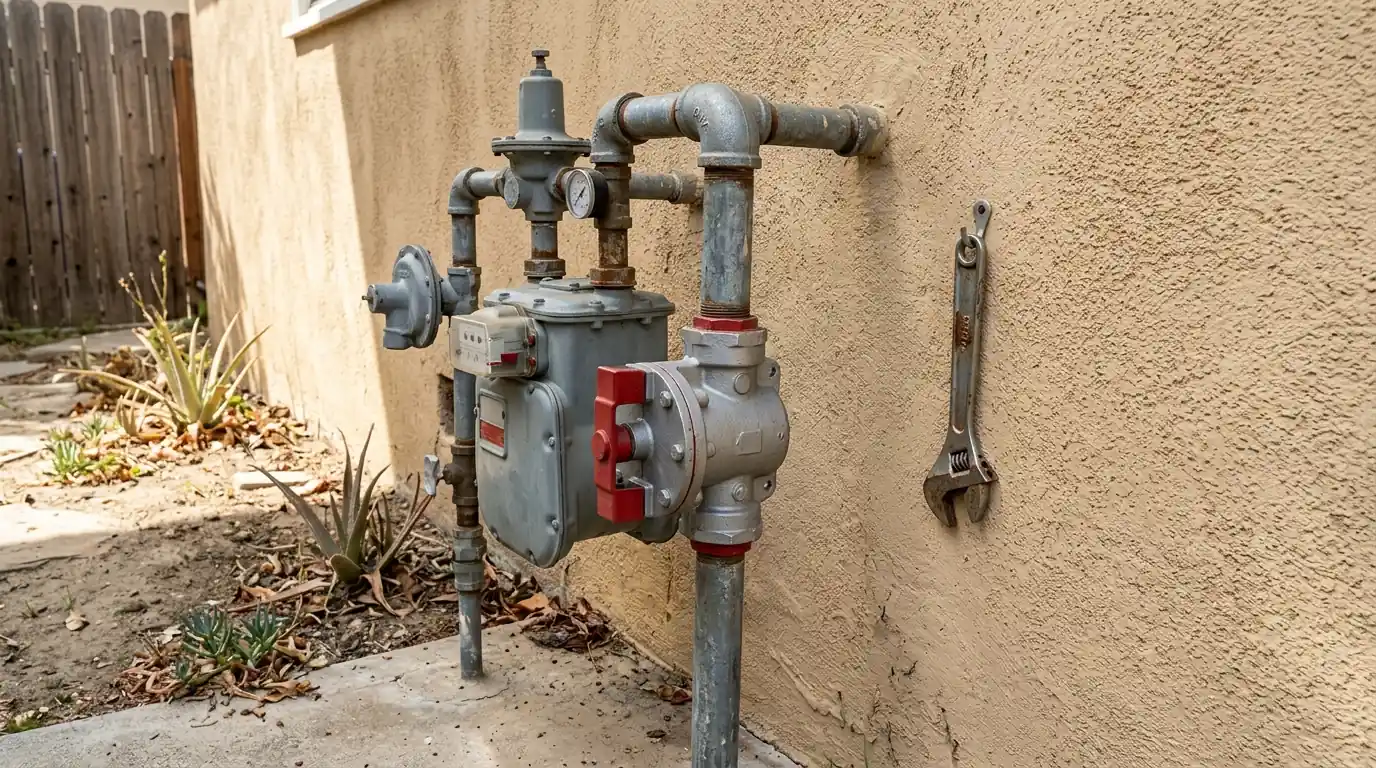
The valve mounts on the customer side of the meter, after the point where SoCalGas equipment ends. Inside the common motion-activated type, a steel ball rests on a small pedestal. Hard shaking knocks the ball off its seat, it drops into the gas path and the valve closes. Nothing downstream gets gas until someone resets it by hand.
Because the valve lives outdoors at the meter riser, it has to be mounted on rigid pipe, level and plumb, and braced so the body can't swing. A valve installed crooked or on a wobbly riser can trip from a passing truck, or fail to trip when it should.
Motion-activated valves versus excess flow valves
There are two kinds of automatic gas shutoff, and Los Angeles building rules generally accept either one. A motion-activated valve reacts to shaking. An excess flow valve reacts to gas flow: if a line breaks and gas rushes out faster than your appliances could ever use it, the valve slams shut.
Each has tradeoffs. A motion valve protects the whole house at once and responds even to breaks that wouldn't raise the flow much, but it can trip from a bump or a nearby jackhammer. An excess flow valve won't trip from shaking alone, so it leaves your gas on after a quake that broke nothing, but it can miss a slow leak from a loose fitting.
- Motion-activated: one valve at the meter, covers every appliance, needs a manual reset after any trip
- Excess flow at the meter: sized to the total house load, closes on a major break
- Excess flow at each appliance: small units on the connectors, often paired with new flexible connectors
- Only state-approved models listed by the Division of the State Architect belong on a California home
When Los Angeles and nearby cities require one
In the City of Los Angeles, permits for new construction and for many larger additions and remodels trigger the requirement, and LADBS inspectors look for an approved automatic gas shutoff before signing off. Building an ADU, adding a story or doing a large kitchen remodel with new gas work are the jobs where homeowners most often hear about it for the first time.
Other cities across Los Angeles County and beyond set their own rules through their own building departments. Some match the City of LA closely, some tie it to a home sale, and a few leave it optional. Check with the building department for your city instead of assuming the LA rule applies.
Even where it isn't required, a valve makes sense for houses with older rigid gas pipe, water heaters in garages and long runs to pool heaters or outdoor kitchens. Before the valve goes in, confirm the tank itself is secured; our strap check guide shows what two properly placed straps look like.
If you smell gas, get out first
No valve replaces the basic rule. If you smell rotten eggs, hear hissing near a gas line or see a broken pipe after a quake, leave the building with everyone in it. Once you're outside and away from the house, call SoCalGas or 911. Don't use light switches, the garage door opener, a lighter or a phone while you're still indoors, since any of them can spark.
Close the gas at the meter only if you smell gas, hear it escaping or see damage, and only once everyone is out. Keep a meter wrench tied to the riser. The shutoff on the meter inlet has a rectangular tang, and a quarter turn so the tang sits crosswise to the pipe stops the flow. After that, SoCalGas has to restore service, so don't close it as a precaution.
Once the utility gives the all-clear, damaged pipe still needs repair before gas comes back on. That's where our gas line repair work starts: we pressure-test the system, find the break and replace the failed section.
Resetting a tripped valve and relighting pilots
Valves trip without a quake more often than people expect: a ladder knocked against the riser, a weed trimmer, or a heavy truck on a hillside street. Before you reset anything, walk the house and sniff near each appliance. If there's any gas smell at all, don't reset; follow the steps above.
Most motion valves reset through a cap on top. You remove the cap, lift the reset stem slowly until you feel the ball seat, and let go. Gas then flows to the house, but every pilot light that went out stays out. Older water heaters, wall furnaces and some ranges need a manual relight, so check each one and follow the instructions printed on the appliance.
If you're uncomfortable relighting, call us or SoCalGas. After a large regional quake the utility gets flooded with relight requests, so learning your own appliances ahead of time keeps hot water and heat from waiting days.
What installation involves and what it typically costs
We start by checking the meter riser and the pipe leaving it. Many older LA houses have a short, corroded nipple there, or a riser too close to a wall for the valve body. Sometimes a new section of pipe and a support bracket have to go in first. We pull the permit where your city requires one, install the valve, leak-test every joint and confirm each appliance relights.
Typical ranges, not a quote: a motion-activated valve on an accessible, sound riser usually runs $350 to $800 installed. Excess flow valves at individual appliances run about $150 to $400 each, more if connectors are replaced at the same time. Repiping at the meter, tight access and permit fees push the total higher. Our seismic valve installation page covers the job in detail, and the same visit is a good time for water heater bracing if yours is missing.