Quick answer
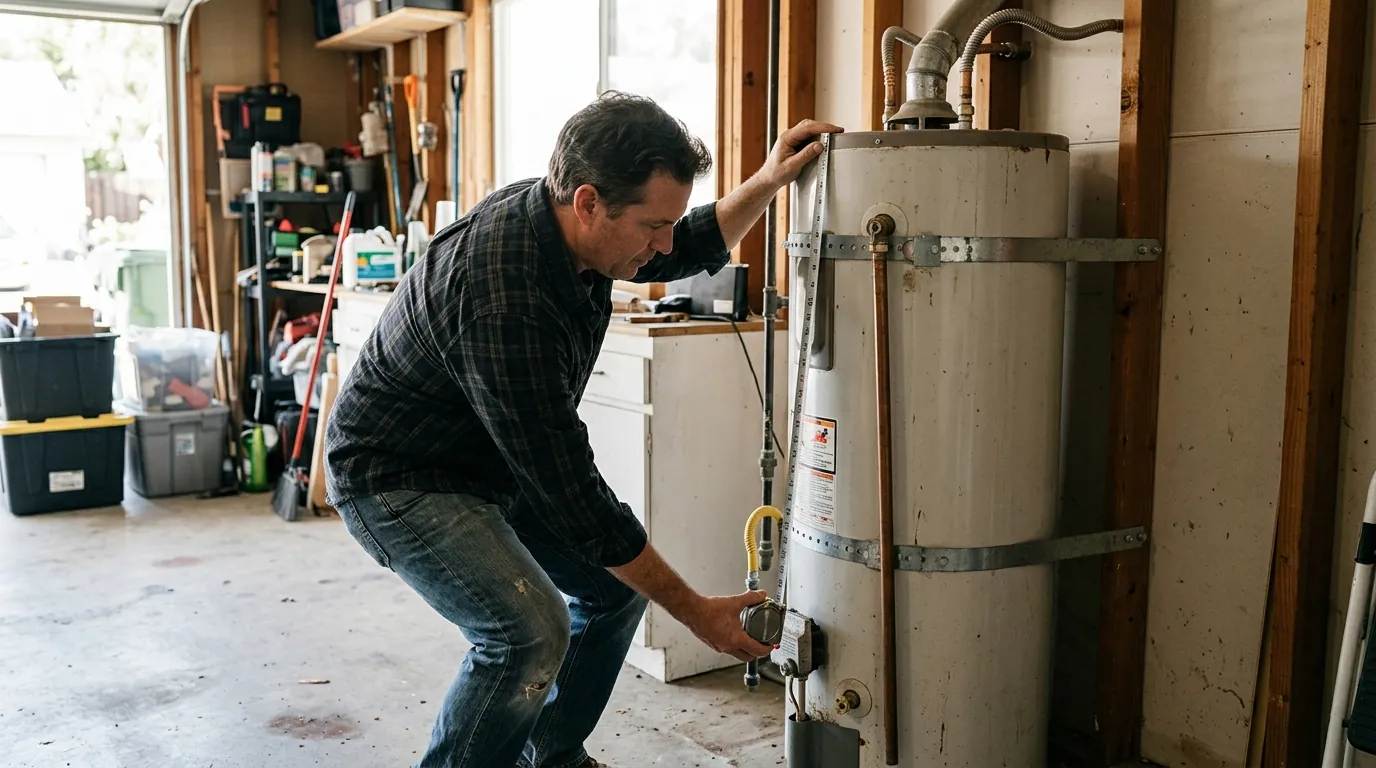
California requires two straps on a residential water heater, one in the upper third of the tank and one in the lower third, each anchored into studs or masonry. Check that both straps wrap the tank snugly, that the bolts bite into solid framing rather than drywall, and that the gas and water lines are flexible so a small shift cannot snap them.
Why water heater straps matter so much in Los Angeles
When the Northridge earthquake hit on January 17, 1994, the magnitude 6.7 shaking toppled water heaters all over the San Fernando Valley. A full tank weighs several hundred pounds, and once it tips, it rips the gas line and the water lines out with it. Gas leaks and flooded garages followed in a lot of those homes.
Strapping costs little next to what a falling tank does. The goal is not to hold the heater perfectly still. It is to keep it upright and stop it from walking far enough to pull its fittings apart, so the gas stays in the pipe and the water stays in the tank.
In older tract houses in places like Reseda and Granada Hills, the heater usually stands in the garage against a framed wall or a block wall. Both can hold a tank well, but each needs a different kind of anchor, which is where most weak installs go wrong.
Where the two straps should sit on the tank
Measure the height of the tank and split it into thirds with a pencil mark. One strap belongs somewhere in the upper third and the other in the lower third. Keep the lower strap clear of the gas control and the burner access cover so it never presses on the valve.
A strap sitting at the middle of the tank does very little, because the tank can pivot around it like a seesaw. We often find a single strap like this in garages where someone added one after buying the house. One strap at the midpoint does not count as two, and a buyer's inspector will note it at sale time.
- Upper strap inside the top third of the tank
- Lower strap inside the bottom third, above the gas control
- Each strap wrapped all the way around the tank, not just across the front
- Both straps fastened to the wall on each side of the tank
Checking the anchors, not just the straps
A strap holds only as well as whatever it is screwed into. Pull on each strap near the wall and watch the bolt head. If the screw sits in drywall alone, it will tear out with the first hard jolt. Lag screws need to go into a stud, and on a block or concrete wall they need real masonry anchors.
In closets and alcoves the studs rarely line up with the tank, so a wood backer board gets screwed across two studs and the straps fasten to that. This works fine as long as the backer itself is lagged into framing. Tap the wall around each bolt. A hollow sound with no stud behind it means that anchor has to move.
Look at the strap material while you are there. Thin perforated plumber's tape, the kind sold on a roll, shows up on a lot of older installs and stretches under load. A heavy gauge kit with a solid band and a tensioning bolt holds far better.
Slack, spacing and the gap behind the tank
Grab the top of the tank and push it firmly side to side. A properly braced heater barely moves. If it rocks an inch or more before the straps catch, they are loose. A loose strap lets the tank build up speed before it stops, and that sudden stop is when fittings snap.
Many tanks stand a few inches off the wall because of the vent pipe or the water lines above. In that case a wood block or spacer goes between the tank and the wall so the straps pull the tank against something solid. Without a spacer, tightening the strap only bends it into a loop that lets the tank swing.
Check the floor under the heater as well. A tank sitting on a raised platform in a garage needs that platform to be solid and fastened down, because straps on a tank perched on a wobbly stand only move the weak point lower. Water heater stands built from loose blocks or scrap lumber should be replaced with a proper stand before the straps are tightened.
Gas and water lines that can move with the tank
Rigid copper or black iron running straight into the heater will crack when the tank shifts even slightly. Flexible water lines and a listed flexible gas line give the heater a little room to move without breaking anything. Trace each line to where it meets the tank. If it is hard pipe right up to the fitting, plan to change it.
Test the gas shutoff valve on the heater supply. It should turn with a small wrench, and you should know which direction closes it. Some homes also have a automatic quake shutoff at the gas meter, which stops the flow during strong shaking. It is worth thinking about when the heater, furnace and range all run on SoCalGas service.
Check the vent too. A gas heater's flue pipe should be screwed together at every joint and sit firmly on the draft hood. A vent that shakes loose sends exhaust into the garage or the house.
When to call a plumber instead of tightening it yourself
If both straps sit in the right thirds, bite into studs and feel snug, you are in good shape. Tightening a loose strap bolt is a fair homeowner job. Moving anchors, replacing plumber's tape with a proper kit, swapping hard lines for flex and adding a spacer are things we handle in one visit as part of our water heater bracing work.
Typical ranges, not a quote: re-strapping an existing tank with a new kit runs about $150 to $350 in Los Angeles, and adding flex lines and a new gas valve on the same visit adds roughly $150 to $400. If the heater is old, rusty at the base or already weeping, money spent bracing it goes into a tank near the end of its life. In that case a new heater installed with straps and flex lines from day one usually makes more sense.
If a tankless unit is on your list for later, our article on choosing between tank, tankless and heat pump covers how each one mounts and what that means for quake safety.