Quick answer
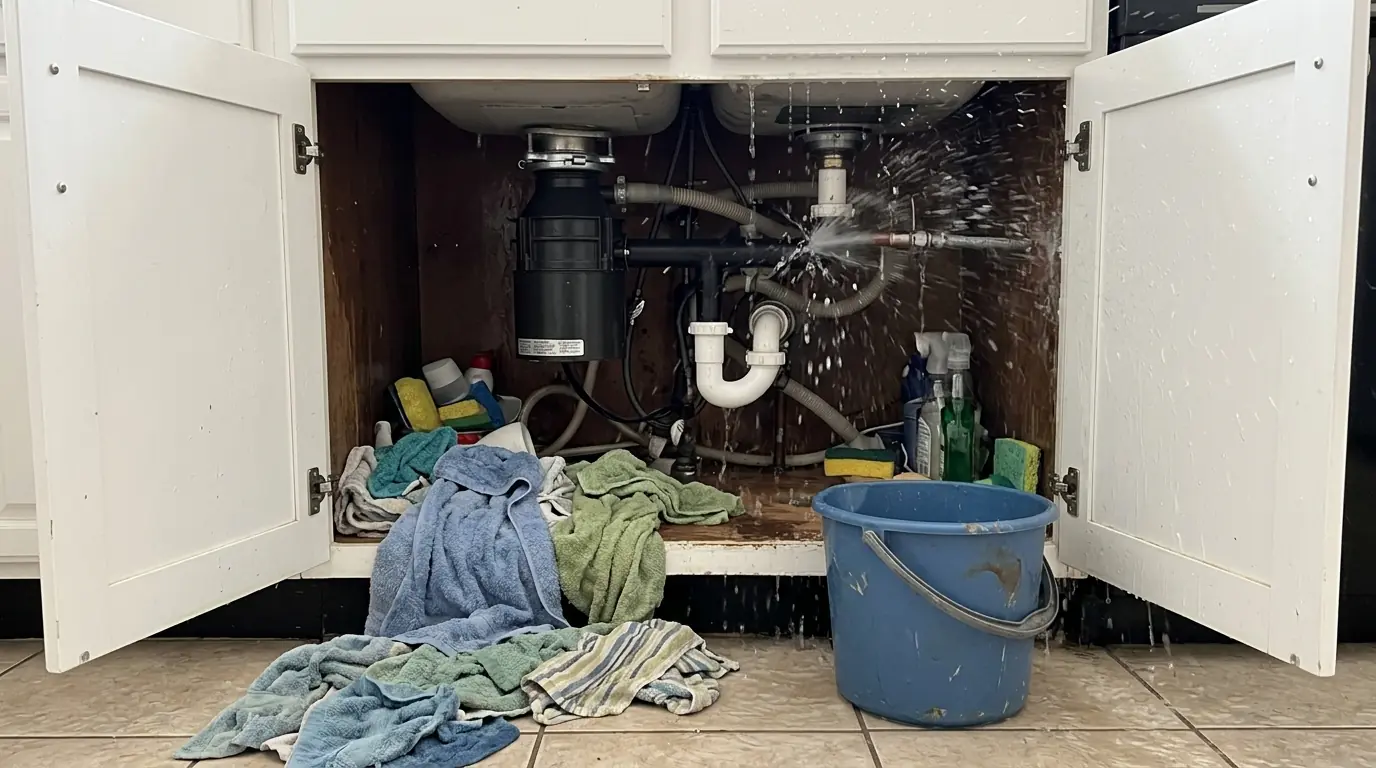
Shut off the water first, at the fixture valve if the break is on a single line or at the main if you can't isolate it. Then keep people away from wet outlets and switch off breakers for flooded rooms. Open a low faucet to drain the lines, move belongings, photograph everything and call a plumber who answers around the clock.
First, close the main water shutoff
Every second the valve stays open, the break keeps feeding water into walls and subfloor, so the shutoff comes before towels, buckets or phone calls. On most San Fernando Valley tract homes built on slabs, the main valve sits where the copper or galvanized supply rises out of the ground, usually on the street side of the house near a hose bib. Raised-foundation houses in older neighborhoods sometimes put it in the crawlspace or under the front porch.
A ball valve takes a quarter turn: when the lever sits crossways to the pipe, it's closed. A round-wheel gate valve needs several turns clockwise, and on decades-old galvanized lines that wheel often seizes or the stem snaps. If the house valve won't budge, go to the meter box near the curb. The LADWP side of the meter has a valve with a flat tang that closes with a meter key or a large adjustable wrench turned a quarter turn.
In condos and apartments, look for a unit shutoff in the laundry closet or behind an access panel near the tub. Failing that, the building manager should know where the riser valves are.
Make the wet area safe before you step into it
Water on the floor finds outlets, power strips and extension cords before you do. If it has reached anything plugged in, switch off the breakers for that room at the panel. If the panel itself is wet, or you'd be standing in water to reach it, leave it alone and keep everyone out of the room until an electrician or the utility can deal with it.
Watch the ceiling. A break in an upstairs bathroom or an attic line often fills the drywall below until it sags like a balloon. Put a bucket under the lowest point and push a screwdriver through the center of the bulge. The water drains in a controlled stream instead of the whole panel dropping at once, and you should stay clear of the area while it empties.
Gas appliances change the priority. If the break is near the water heater or furnace and you smell rotten eggs or hear hissing, stop working on the water. Get everyone out of the building, then call SoCalGas or 911 from outside before you do anything else. Don't flip switches or use a phone indoors on your way out.
Drain the lines and take the load off the water heater
Closing the main stops new water, but the pipes still hold what's already inside them. Open a cold faucet at the lowest point of the house, such as a tub spout or an outside spigot, and the remaining water drains there instead of out of the break. Flush a toilet once to empty its tank as well.
Next, set the water heater so it isn't heating against a closed system. On a gas tank, turn the control knob to the vacation or pilot setting. On an electric tank, switch off its breaker. Tankless units can stay powered, but there's no reason to run hot water through them until the line is repaired.
- Pull rugs, cardboard boxes and books off the wet floor first, since they wick water fastest
- Set furniture legs on foil, plastic lids or wood blocks so finish stain doesn't bleed into carpet
- Run a wet-dry vacuum or push standing water toward a door with a squeegee
- Open windows and run fans once the power in that room is confirmed safe
Photograph everything for the insurance claim
Before you clean too much, take wide photos of each wet room and close-ups of the break, the water line on the walls and any damaged belongings. Note the time you found the leak and the time the water went off.
Keep the failed piece. When we cut out a split fitting or a burst supply hose, we bag it and hand it to you, because an adjuster may want to see whether it was a sudden failure or slow corrosion. Many homeowner policies treat those two very differently, so the physical evidence matters.
Drying can't wait for the adjuster. Wet drywall and carpet pad start to smell musty within a day or two, so start drying the same day.
Why pipes burst in Los Angeles without a freeze
Frozen pipes are rare here, though foothill neighborhoods like Sunland-Tujunga see the odd hard frost on exposed hose bibs. Most of the breaks we repair have other causes, and knowing which one hit your house tells you whether more are coming.
After any burst, ask for a static pressure reading at a hose bib. It shows whether the break was a one-off or a sign of pressure that will find the next weak joint.
- High static pressure. Homes on downhill streets can see pressure well above what fixtures are built for, and a failed regulator lets it climb. A new pressure regulator protects every line in the house.
- Old galvanized steel that has rusted from the inside until the wall thins out. If you're seeing repeat leaks, our guide to patching versus repiping galvanized lines lays out the options.
- Braided supply hoses on toilets, faucets and washing machines that are years past their service life.
- Slab movement in expansive clay soils, which can crack copper under the floor. Warm spots and hissing are covered in our article on slab leak warning signs.
- Earthquake shaking. The 1994 Northridge earthquake split pipes and fittings all over the Valley, and smaller quakes still loosen joints that fail later.
What to tell us when you call, and what the repair costs
Call the line any hour and have four answers ready: where the break is, what the pipe looks like (shiny copper, gray galvanized, white or red plastic), whether the water is off, and whether the leak is in an open area, inside a finished wall or possibly under the slab. That lets us load the right fittings and decide whether to bring leak detection gear. Our after-hours plumber answers nights, weekends and holidays.
On arrival we confirm the shutoff holds, open only as much wall as the repair needs, and cut back to sound pipe. Copper gets new copper with soldered or press fittings, and PEX gets matching material. Before we leave, we refill the system slowly, bleed the air and pressure-check the repair. If your main valve fought you, a replacement shutoff is worth doing while we're there.
Typical ranges, not a quote: an exposed break under a sink or in a garage often runs $350 to $900. A break inside a finished wall with an access cut and a short section of new pipe is more like $900 to $2,500. Slab breaks, drywall patching and drying are separate costs. More detail on the work itself is on our burst pipe repair page.